
 Telegram
Imagine you're a fisherman. There are plenty of people around you, but they're just a general audience. But the one who came up, took an interest in your bait, and asked what you're catching with — that's a completely different story. That is a lead.
In marketing, a lead is not just a random passerby. It's a potential customer who noticed your product or service, showed interest in them, and, most importantly, left their contact information for communication.
The Path from Simple Curiosity to a Real Lead
The ability to turn ordinary visitors into leads is the foundation of any successful business. A lead is not someone who just liked your social media post or visited your website. It's a person who took a step towards you.

How does a passive observer become an active lead? It happens the moment they perform a specific conversion action. For example:
- fills out a feedback form to ask a question;
- subscribes to your newsletter to get a bonus or discount;
- downloads useful material — a guide, checklist, or e-book;
- registers for a webinar or requests a free consultation.
This very moment, when a person voluntarily gives their contact info in exchange for something valuable to them, is the point of conversion. The customer's journey begins with this contact, and your sales department will work with them further.
The key difference between a lead and an ordinary visitor is a conscious interest and consent to dialogue, backed by contact data. This allows the business to start a meaningful conversation rather than shooting in the dark.
This approach saves resources because you focus not on the entire audience, but only on those who are already "warm" and ready to listen. In Ukraine, the lead generation market is growing actively, especially thanks to digital tools and CRM systems.
How to Differentiate Leads by Temperature
Imagine you're selling umbrellas. On a sunny day, a passerby glances at the window and thinks, "Maybe I'll need it someday." Another one enters the shop because the weekly forecast promises rain. And a third one flies inside when a downpour has already started outside. Obviously, their desire to buy is completely different.
That's exactly why marketing has a classification of leads by "temperature." It's a simple but effective scale that shows how close a potential customer is to a deal. Understanding temperature helps distribute efforts correctly: don't pressure those who aren't ready, and don't miss the moment with those who just need an invoice.
Cold Leads
Cold leads are people who are just starting their journey. They might have just realized their problem or are simply interested in the topic, but are not yet looking for a specific solution. This is your target audience, but at this stage, they have no urgent need for your product.
Their actions are usually quite passive:
- Read general articles on your blog.
- Subscribe to your social media page to follow content.
- Accidentally land on the site through informational queries in search engines.
Working with such contacts is a long game. Your goal is to gradually "warm them up" by sharing useful information and demonstrating your expertise. When the need becomes acute, they will remember exactly you.
Warm Leads
Warm leads are a completely different story. They clearly understand their problem and are actively looking for options to solve it. They are already familiar with your company, compare you with competitors, and weigh all the pros and cons.
Warm leads are the golden mean. They are already interested but not yet fully convinced. This is where quality communication and the ability to handle objections play a key role.
Here's how warm leads behave:
- Download your price list or a detailed commercial proposal.
- Carefully study service description pages, cases, and reviews.
- Leave their email in exchange for demo access, a checklist, or a discount.
Hot Leads
Hot leads are the most valuable contacts for any business. They are ready to buy here and now. Their need is fully formed, they have already chosen you as one of the favorites and are waiting for the final step.
The actions of a hot lead cannot be confused with anything else:
- Fills out a "Request a consultation" or "Calculate cost" form.
- Adds a product to the cart.
- Calls you directly to clarify order details.
With such leads, you need to act instantly. Any delay can cost you a customer who will simply go to faster competitors.
To better understand the difference, let's look at the summary table. It will help you quickly identify who you're dealing with.
Comparison of Lead Types by Temperature
| Criterion | Cold Lead | Warm Lead | Hot Lead |
|---|---|---|---|
| Problem awareness level | Low. Just found out about the problem or topic. | Medium. Actively looking for a solution, understands the problem. | High. Knows exactly what he needs and is ready to act. |
| Brand familiarity | Minimal. Might be seeing you for the first time. | Yes. Has already interacted with your content, knows about you. | High. Considers you as a primary candidate. |
| Typical behavior | Reads blog, subscribes to social media. | Studies service pages, downloads price list, compares. | Leaves a request for consultation, calls, adds product to cart. |
| Readiness to buy | Very low. Doesn't plan to buy in the near future. | Medium. Considers the possibility but is still hesitating. | Very high. Ready to buy now or in the near future. |
| Main goal of work | Educate, inform, build trust. | Persuade, handle objections, demonstrate value. | Respond quickly, close the deal, don't let them leave. |
As you can see, each type of lead requires its own approach. Ignoring the "temperature" is one of the most common mistakes that leads to wasted time and budget.
The Lead's Journey from Awareness to Purchase
Turning a total stranger into a regular customer is not magic, but a clearly thought-out process. This path is called a sales funnel, and it consists of several stages through which every potential buyer passes. If you understand this logic, you can delicately lead a person from the first "hello" to the final deal.
The customer's journey starts even before they find out about you and ends when they're already ready to hit the "buy" button. And every step on this path requires a special approach to warm up interest and build trust.
Funnel Stages: How the Customer "Warms Up"
The entire lead conversion process can be conventionally divided into three major stages. They correspond exactly to their "temperature" — that is, how ready they are to buy.
-
Top of the Funnel (TOFU). This is the awareness stage. Cold leads gather here — people who have just realized their problem or are simply looking for information. Your task is to attract their attention with useful content but not to sell anything head-on. Blog articles, interesting social media posts, and SEO will work perfectly.
-
Middle of the Funnel (MOFU). It's getting warmer here. Leads at this stage already know about you and consider your product as one of the possible solutions. They actively compare options, so they need proof of your expertise. It's time to offer them cases, webinars, useful email newsletters, or detailed guides.
-
Bottom of the Funnel (BOFU). And it's hot here! At this stage, leads are almost ready to buy; they only need a final push. Offer a free consultation, a product demo, a special offer, or testimonials from satisfied customers. This will help dispel final doubts and close the deal.
This infographic perfectly illustrates how a lead gradually "warms up" as they move through the funnel.
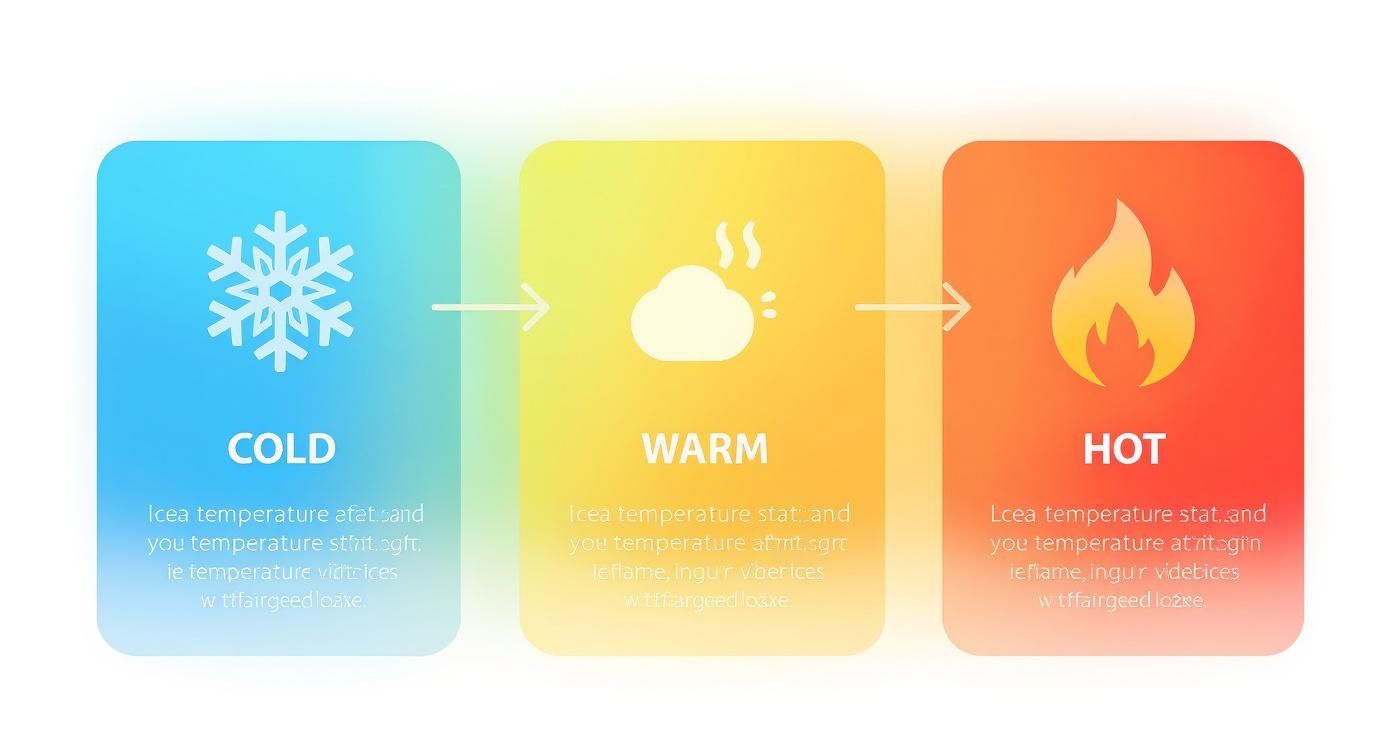
As you can see, the main idea is simple: at each stage, give the potential customer exactly the information they need right now. No more, no less.
Most Effective Channels for Lead Acquisition
Alright, we've covered the theory. But the main question for any business remains unchanged: "where to get customers?". Channel selection is always a mix considering your niche, budget, and ideal buyer profile. But there are several proven methods that consistently yield results.
By the way, you shouldn't grab everything at once. Better choose 2–3 most promising channels for yourself, squeeze the maximum out of them, and then experiment with others.
SEO and Content Marketing: A Long Game
Search engine optimization (SEO) and creating great content is a marathon, not a sprint. There won't be instant results here. However, in the long run, this is one of the most reliable ways to get a steady stream of "warm," organic leads.
Imagine: a person Googles a solution to their problem themselves, finds your comprehensive article or useful guide, and realizes you're an expert. They are already interested. You just have to gently suggest the next step: subscribe to a newsletter, download a checklist, or sign up for a consultation.
SEO is not so much about fast sales as it is about building trust. When your site is at the top of Google search results, it's a powerful signal for a potential customer: these people can be trusted.
Targeted and Contextual Advertising: Fast Results Here and Now
If leads were needed "yesterday," your choice is paid advertising. It allows you to instantly launch traffic, test hypotheses, and get the first applications, sometimes even in a few hours.
- Contextual advertising (Google Ads) works great for a "hot" audience. You just show an ad to those who are already actively looking for your product or service. This is, in fact, a direct response to established demand.
- Targeted advertising (Facebook, Instagram) allows you to finely tune the display to people based on their interests, age, geolocation, and behavior. Perfectly suited for visually attractive products where you can "hook" with emotion.
To effectively collect contacts from paid advertising, landing pages are usually created. If you want to understand this in more detail, read our article about what a landing page is and how it works.
Email Marketing: The Art of Building Relationships
Email marketing is often underestimated, and that's a mistake. It's a high-powered tool to "warm up" an existing contact base and turn barely interested people into loyal customers.
With the help of regular emails, you can share useful information, talk about new products, announce promotions, and show your expertise. The main rule here is simple: give value first, and sell only after. This is how long-term relationships are built, which bring repeat sales and create an army of fans for your brand.
How to Tell if Your Lead Generation Efforts are Working?
Launching an ad and not analyzing the results is like driving with your eyes closed. It seems you're moving somewhere, but where, why, and at what cost — is unclear. To prevent your marketing campaigns from turning into a waste of money, you need to track key performance indicators, or KPIs.
These are not just some abstract numbers in a report. These are real indicators of your business's health that clearly show which channels bring in paying customers and which ones just "eat" the budget.
Key Metrics to Keep Under Control
To evaluate how profitably you're investing money in marketing, it's enough to understand a few basic indicators.
-
Cost Per Lead (CPL). This is perhaps the very first metric everyone looks at. It shows how much it costs you to contact each interested person.
- How to calculate:
Total marketing campaign costs / Number of leads received - For example: you spent 5,000 UAH on Instagram ads and got 50 applications. That means your CPL is 100 UAH.
- How to calculate:
-
Conversion Rate. This indicator illustrates what percentage of potential customers (leads) becomes actual ones. It helps to understand how high-quality the leads you attract are and how well your sales department works. We've already written in detail about what conversion is and how to increase it.
-
Customer Acquisition Cost (CAC). And this is the final cost of one customer who didn't just inquire but paid you money.
- How to calculate:
Total marketing and sales costs / Number of new customers
- How to calculate:
Understanding the difference between CPL and CAC is fundamentally important. A cheap lead is not a victory yet. You can drive hundreds of leads at 10 UAH each, but if none of them buy anything, you've just thrown money to the wind.
- Lifetime Value (LTV). This is a forecast of how much money one customer will bring you over the entire time of your cooperation with them.
When you compare LTV and CAC, you see the real picture. If a customer brings you significantly more money over time (LTV) than you spent on acquiring them (CAC), your business is on the right track. If it's the other way around — it's time to urgently review the strategy.
Automating Lead Management through CRM
When the flow of applications grows, managing them manually in Excel or a notebook is a direct path to chaos. Information gets lost, managers get confused in statuses, and potential customers, tired of waiting for a response, go to competitors. This is precisely the moment when CRM systems (Customer Relationship Management) take the stage.
It's not just a trendy "address book." It's a full-fledged command center for working with customers, which collects leads from all channels in one place:
- Website forms
- Social media messages
- Emails
- Phone calls
As soon as someone leaves an application, the CRM itself creates a contact card, assigns a responsible manager, and sets them a task. The human factor is minimized. Thanks to this, not a single lead will be lost, and the team will be able to focus on communication and sales rather than routine data copying.

Modern systems, such as CMF Atom with a lead tracking module, allow you to see the entire sales funnel at a glance. You clearly understand what stage each customer is at and what needs to be done to push them towards a purchase.
Switching to a CRM is like moving from a bicycle to a car. Research confirms that companies implementing CRM can increase lead conversion by 300%.
A properly configured system becomes a real engine for business, which saves time and helps not to lose money. If you're already considering such a tool, take a look at our detailed guide on how to choose a CRM for small business.
Frequently Asked Questions about Leads
Finally — a few answers to questions we most often receive from entrepreneurs. This will help you reinforce the material and avoid common pitfalls.
What is the difference between a lead and a contact?
Imagine you've returned from a business conference with a pile of business cards. Those are all contacts. That is, just data: name, phone, company. Но who of these people is really interested in your product, and who was just being polite? Unknown.
But a lead is already that contact who has shown a specific interest. They don't just sit in your database but took a step forward: left a request on the site, subscribed to a newsletter, or asked to be sent a price list.
In simple words: every lead is a contact, but far from every contact is a lead.
How to quickly tell if a lead is of good quality?
The fastest way is to look at where the person came from and what exactly they did. Agree, there's a difference between someone who filled out the "Calculate project cost" form and someone who just liked your Instagram post. The first is obviously "hotter."
Here's a quick checklist for checking a lead:
- Source: Where are they from? A "buy CRM system in Kyiv" query is much more valuable than a click from an entertainment video.
- Action: What did they do? Ordered a callback from a manager or just downloaded a free guide?
- Data: How completely did they fill out the form? Did they only provide a name or leave a detailed comment?
What are the first steps for a small business with a zero budget?
Great news: you don't need big money to start generating leads. The main thing is to focus on where you can give customers real value.
- Create a simple landing page or a page on your site. This is your "base" where you will lead people.
- Come up with a lead magnet. What can you offer in exchange for contacts? It can be something simple: a discount on the first order, a useful checklist, or a short consultation.
- Choose 1–2 channels to start with. Don't try to be everywhere at once. Start, for example, by running a page on a social network where your audience hangs out, or work on basic SEO optimization of the site.
The main thing is to start. Start building a database of interested contacts, even if there are very few of them at first.
If you want not just to collect contacts, but to turn them into real money with the help of a modern website and automation, contact Moveiton. We create web solutions that help businesses grow. Learn more about our opportunities for your business.