
 Telegram

Imagine your website as a regular store. The people who walk in are your traffic. And those who don’t just browse the window displays but make a purchase, leave their contact details, or subscribe to promotions — those are your conversions. Essentially, this is the key metric that turns random visitors into real customers.
What a website conversion is in simple terms
A conversion is any target action a user takes on your website. And it’s not always directly about money. For a business, the main thing is that a visitor doesn’t just scroll through pages, but interacts with them, step by step moving toward the final goal. Such an action can be large (a macro conversion) or very small (a micro conversion), yet each has its own value.
Think of the customer journey like a staircase where each step leads to a purchase. For example, clicking an ad banner, subscribing to an email newsletter, or adding a product to the cart — these are all micro conversions. They don’t generate profit at that very moment, but they clearly signal interest.
Conversion is that moment of truth when a visitor stops being just a “guest” and becomes a customer, a buyer, or at least a potential lead. It turns abstract interest into a concrete, measurable action that matters for the business.

Here is a brief classification to help you understand the types of target actions and what they mean for different kinds of businesses.
Examples of conversions for different business types
| Conversion type | Example action | Who finds it important |
|---|---|---|
| Macro conversion (primary) | Placing an order, paying for a service | Online stores, subscription services |
| Micro conversion (supporting) | Newsletter subscription, downloading a price list | B2B companies, content projects, blogs |
| Lead conversion | Filling out a contact form, requesting a consultation | Agencies, developers (real estate), educational courses |
| Engagement conversion | Watching a video, commenting on an article | Media, influencers, brands |
This table shows that for each business, “conversion” can mean something different, but the goal is always the same — to get a valuable action from the user.
Why conversion matters more than traffic
You can drive thousands of people to your site, but if none of them buy anything, the business won’t earn a penny. High traffic without conversions is like a concert hall packed with people who didn’t buy tickets. Good for crowd shots, but pointless financially.
This is why the main objective is not just to attract an audience, but to persuade them to act. That’s why Conversion Rate Optimization (CRO) is a top priority for any online project. Even a slight improvement in this metric can noticeably increase revenue — without extra ad spend.
Conversion as a business health indicator
Tracking conversions is like running a medical check-up for your business. It helps you understand how effectively your site and marketing campaigns are working. Low figures can be symptoms of serious issues:
- Unclear value proposition: Visitors don’t understand what benefit you’re offering.
- Complicated navigation: People get lost and can’t find the needed information or the “Buy” button.
- Technical glitches: The site takes ages to load or throws errors, scaring off potential customers.
Analyzing these points helps you identify weak spots and fix them quickly. By the way, Ukrainian e-commerce shows an interesting trend: in the first half of 2024, conversion rate increased by 50% despite overall traffic dropping by 9%. This indicates businesses got much better at working with existing audiences. Read more in the Ukrainian e-commerce report by Promodo.
How to correctly calculate conversion rate
Knowing what a conversion is is only half the battle. It’s far more important to measure it correctly, because without precise numbers, any improvement attempts are just stumbling in the dark. Enter the key metric — conversion rate, or CR.
In simple terms, this metric shows what percentage of your website visitors did exactly what you wanted them to do. It clearly demonstrates how effectively your site turns plain traffic into real money or leads.
The formula every marketer should know
You can calculate CR with an extremely simple yet powerful formula. It turns the abstract idea of “effectiveness” into a concrete, measurable number.
Conversion Rate (%) = (Number of conversions / Total number of visitors) * 100%
Let’s take a live example. Suppose your site had 10,000 unique users in a month, and there were 200 purchases. Plug the numbers into the formula:
(200 purchases / 10,000 visitors) * 100% = 2%
This means your site’s conversion rate is 2%. In other words, two out of every 100 visitors become your customers. This figure is your main guide for further work.
Macro and micro conversions: don’t ignore the small stuff
One of the most common mistakes is tracking only the final, primary goal — say, paying for an order. That’s a macro conversion. But on the way to it, people take many smaller intermediate steps — micro conversions.
Ignoring them is like trying to understand a movie’s plot by watching only the final scene. Tracking micro conversions helps you see where in the customer journey difficulties arise and where potential customers “drop off.”
-
Example for an online store:
- Macro conversion: Order completed and paid.
- Micro conversions: Adding a product to the cart, subscribing to price-drop alerts, creating an account.
-
Example for a B2B site:
- Macro conversion: A completed consultation request form.
- Micro conversions: Downloading a price list, viewing the case studies page, clicking the phone number.
-
Example for a blog:
- Macro conversion: Subscribing to the email newsletter.
- Micro conversions: Scrolling to the end of the article, leaving a comment, clicking an affiliate link.
When you analyze micro conversions, you might suddenly notice that hundreds of people add items to the cart, yet only a few proceed to payment. That’s a clear signal: something is wrong with the checkout process. Specialized systems help you manage this data effectively. To learn more about how a CRM for small businesses can help track the customer journey, check out our detailed guide.
By the way, the Ukrainian e-commerce market shows interesting figures. According to a 2025 e-commerce market study, the average conversion rate in the “food” niche reaches 7.90%, “health” — 7.23%, and “home goods” — 6.49%. The leaders are “e-cigarettes” (8.72%) and “pet products” (8.58%). In these categories, roughly every 12th visitor becomes a buyer — another proof that conversion analysis is key to choosing promising markets.
Main tools for tracking conversions
To improve something, you need to be able to measure it. Fortunately, the days when marketers acted blindly are long gone. Today, we have a whole arsenal of powerful tools that let you see virtually every user step and understand what exactly pushes them toward the target action.
Any optimization attempts without reliable analytics are just shooting blindfolded. So let’s see how to build a system that becomes your eyes and ears.
Google Analytics 4 (GA4) — the foundation of your analytics
Let’s start with the essential. Google Analytics 4 is, without exaggeration, a must-have for any website. It lets you do more than count visitors — you can dive deep into their behavior. The key difference from older versions is that GA4 centers all analytics around events, making it incredibly flexible.
In GA4, you can turn any important action on the site into a conversion event. For instance:
purchase— the obvious macro conversion for an online store.generate_lead— records form submissions on a B2B site.sign_up— tracks new user registrations for a service.
Once you mark an event as a conversion, GA4 starts collecting dedicated stats for it. You immediately see which traffic sources, campaigns, or pages deliver the most results. To better understand where your customers come from, check our detailed Google Search Console guide.
Google Tag Manager (GTM) — flexibility and speed
If Google Analytics is the brain of your analytics system, then Google Tag Manager is its nervous system. GTM is a free intermediary tool that lets marketers add tracking codes (tags) to the site without bothering developers over every little change.
Imagine you need to hang ten paintings. Without GTM, you’d call a handyman for each painting to drill into the wall. With GTM, you call the handyman once to install a universal rail, and then you hang the paintings yourself whenever and wherever you want.
With GTM, you can set up tracking of button clicks, form fills, or even page scrolls in minutes and then send this data to Google Analytics. This dramatically speeds up work and gives marketers full freedom.
CRM systems for long sales cycles
For many businesses, especially B2B or high-ticket services, the customer journey doesn’t end on the website. After a person submits a request, a long process begins: calls, meetings, commercial proposals. The final conversion — signing a contract — happens offline.
This is where CRM systems (Customer Relationship Management) come in. They unify site data with everything that happens afterward. Integrating CRM with analytics allows you to track the entire customer journey — from the first ad click to money in the account a month later. In such niches, it’s the only reliable way to calculate true marketing ROI (ROMI).
Facebook and TikTok ad pixels
If you actively acquire customers via paid social ads, pixels are your weapon. Facebook Pixel and TikTok Pixel are small code snippets installed on your site that do two key things:
- Track ad-driven conversions. The pixel records when a user who came from an ad makes a purchase or submits a form. This tells you exactly which creatives and audiences bring revenue.
- Build retargeting audiences. The pixel collects data on site visitors, enabling you to “follow up” with ads — for example, to people who added items to the cart but didn’t buy.
Combining these tools creates a powerful, end-to-end analytics system — the solid foundation for effective conversion optimization.
Key factors that influence conversion and how to improve them
Understanding what a conversion is and how to measure it is important, but it’s just the tip of the iceberg. The real work starts when you systematically improve it — a process called Conversion Rate Optimization (CRO). The goal is to find and remove barriers that stop people from doing what you want.
Think of your site as a complex yet well-oiled machine. Every screw — from the button color to page load speed — matters. If even one part malfunctions, the whole mechanism slows down, and you lose customers. Let’s break down the key elements that directly affect your results.
Clear, user-friendly UI/UX
UI/UX isn’t about “making it pretty.” It’s about making it easy and obvious for users to navigate your site. If someone can’t find the “Buy” button within three seconds or gets lost in a complex menu, they’ll close the tab — and likely go to a competitor.
What can you improve?
- Keep navigation simple. Menus should be logical, and the path to key pages as short as possible. No scavenger hunts.
- Make it responsive. Most people are on the internet via phones. Your site must look perfect on any screen.
- Keep the interface clean. Don’t overload pages with banners, icons, and text. Every element should serve a function and guide the user to the goal.
When building a site, always think like your customer. To see how this works in practice, check our detailed guide on what a landing page is and how it works.
Page load speed
Online patience is measured in milliseconds. Studies show even one extra second of load time can reduce conversions by 7%. If your site “thinks” for more than three seconds, you risk losing nearly half your potential customers before they even see your offer.
Site speed isn’t a mere technicality — it’s respect for your customer’s time. The faster you give them what they came for, the more likely they are to stay.
Check your site with tools like Google PageSpeed Insights. Optimize images, minify code, use caching — do whatever it takes to make pages fly.
Compelling calls to action (CTAs)
The call-to-action button is the final nudge that should convince a visitor to act. Vague, invisible, or boring CTAs are a main cause of low conversion.
What makes a CTA effective?
- Action-driving copy. Instead of a dry “Submit,” write “Get a free consultation” or “Order with a discount.”
- Contrasting design. The button should stand out immediately.
- Right placement. Put CTAs where users are ready to act — e.g., right after the product benefits section.
Content quality and social proof
People don’t buy products — they buy solutions to their problems. Your task is to show how your offer helps them. You need quality content: detailed product descriptions, helpful blog posts, video reviews.
Equally important is social proof: real customer reviews, ratings, case studies, or logos of well-known companies you’ve worked with. Stats show that for 93% of consumers, online reviews are a decisive factor in purchases. Demonstrate that others trust you, and new customers will find it easier to choose you.
This infographic simply illustrates how analytics helps improve results. 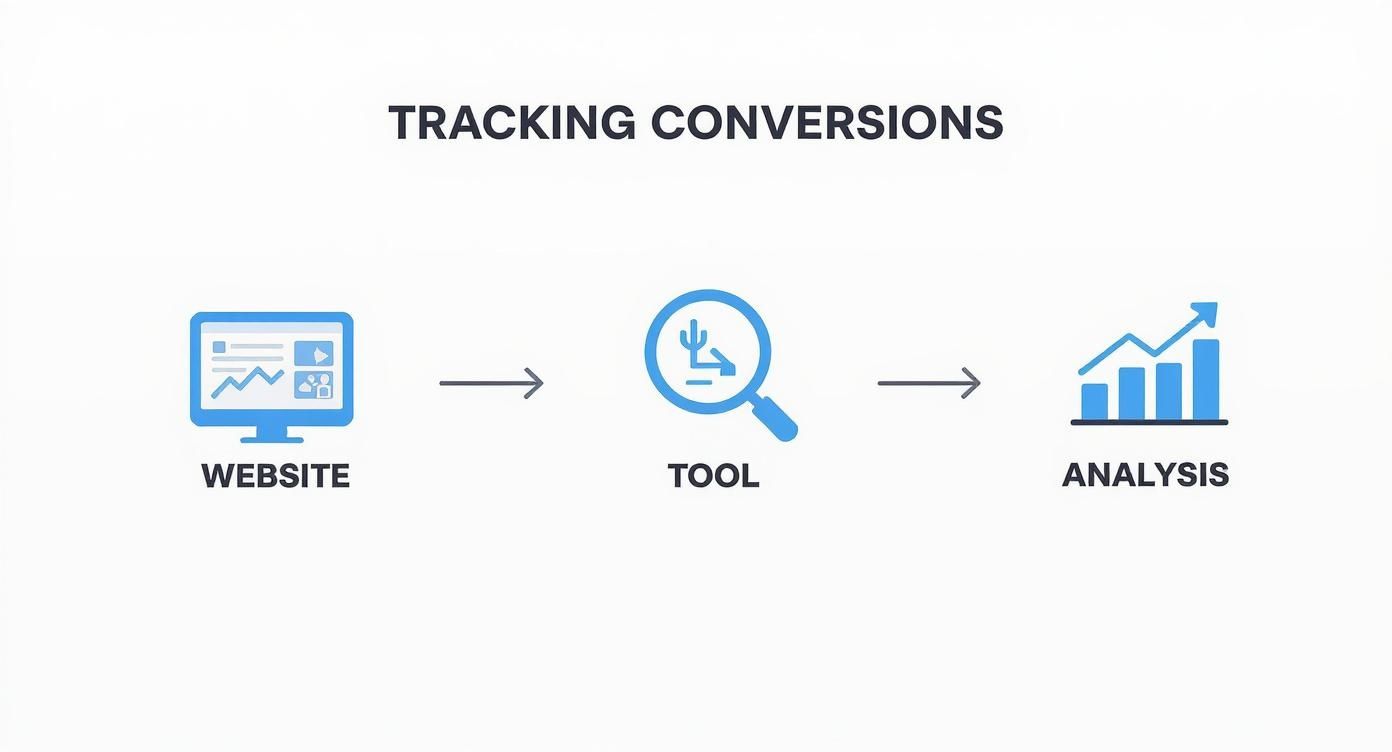 As you can see, it all boils down to a simple cycle: the site generates data, tools collect it, and you analyze it. This lets you make decisions based on facts, not guesses.
A/B testing to validate hypotheses
How do you know which headline works better? Or which button color — green or orange — gets more clicks? The answer: A/B testing.
The method is simple: create two versions of a page (A and B) that differ by just one element. Split traffic in half: one half sees version A, the other sees version B. After gathering enough data, analyze which version achieved a higher conversion rate. It’s the only reliable way to make decisions based on real user behavior. For example, changing a headline from “Our services” to “We help businesses earn more” can boost submissions by 20–30%.
Here’s a fun fact: Ukrainian businesses are increasingly using mobile channels to communicate with customers. According to a study, conversion rates reach 7.67% in In-App, 6.24% in Viber, while Email is only 2.78%. This clearly shows how important it is to be where it’s convenient for your customers. Read more in the Ukrainian market study by Esputnik.
Common mistakes that kill your conversion
Even perfectly set analytics won’t help if the site itself scares off potential customers. Businesses often pour thousands into ads without realizing money leaks due to trivial mistakes. It’s like trying to fill a leaky bucket — no matter how much water you pour, it stays empty.
Let’s review the most common “holes” that eat your budget and turn interested visitors into disappointed escapees.

Overly complicated checkout form
The worst enemy of conversions is extra steps. Imagine someone is ready to pay you, and you force them to fill out ten fields, including ZIP code and mother’s maiden name. The more fields, the higher the chance the user will just close the tab.
Remember: every additional step in checkout is another chance for the customer to change their mind. The ideal is a one- or two-click purchase.
Ask only for information that’s critical to fulfill the order: name, phone number, and delivery address. The rest can be clarified over the phone or made optional.
Unclear value proposition
When a person lands on your site, they have literally 3–5 seconds to find answers to three questions:
- What do you actually offer?
- Which of my problems does it solve?
- Why should I buy from you and not from the store next door?
If your homepage greets visitors with vague phrases like “a dynamic, fast-growing company” or “innovative business solutions,” consider that visitor lost. Be specific. Compare: instead of “we are market leaders,” write “We deliver pizza in 30 minutes or it’s free.” See the difference?
Unexpected costs at the final step
A classic trap that kills sales at the finish line. The customer has added an item to the cart, entered details, and is about to click “Pay” — and then notices the final amount increased by 150 UAH due to shipping or a hidden fee.
This approach breeds irritation and the feeling of being tricked. Always show the full cost as early as possible. Even better — offer free shipping by factoring it into the price. Transparency is the key to trust.
Ignoring the mobile version
Today, over 60% of internet traffic comes from mobile devices. If your site isn’t optimized for smartphones, you’re voluntarily giving up most potential customers. It’s no longer optional — it’s mandatory.
Open your site on a phone. Are the buttons easy to tap? Does the text stay within the screen? Is the information easy to find? If any answer is “no,” you urgently need mobile optimization.
Driving irrelevant traffic
You can have the best site in the world, but if people arriving don’t need your product, there will be no conversions. This common mistake happens when ad campaigns target too broad an audience.
For example, you sell luxury Swiss watches, but your ads target students. They might click out of curiosity but will never buy. It’s better to attract 100 targeted visitors than 1,000 random ones. Carefully analyze traffic sources and don’t fear narrowing the audience to those who can actually become customers.
Frequently asked questions about conversion
When dealing with a topic this broad, there are always small but important nuances. We’ve collected some questions we often hear from clients and beginner marketers and tried to answer them simply and clearly.
This section is your quick cheat sheet. Come back to refresh key points or dispel doubts.
What conversion rate is considered good?
Probably the number one question. The answer is always the same: there’s no universal “gold standard.” A good CR depends on many factors: your niche, traffic source, average order value, and even the country you operate in.
For example, for an apparel e-commerce site in Ukraine, 2–3% is a great result. For a real estate developer selling apartments, even 0.5% can be a real success because a single order covers all costs.
To give you a benchmark, here are rough ranges for different areas:
- E-commerce (mass-market goods): 1–3%
- B2B services (high-ticket): 0.5–2%
- SaaS (subscriptions): 2–5%
- Online courses and education: 3–7%
The most important thing is not to chase abstract market averages but to monitor your own trend. If your CR steadily grows month over month, you’re on the right track. Keep going and keep improving.
Why is there a lot of traffic but few conversions?
A classic “leaky bucket” situation. You pour money into ads, people visit the site, but leave without doing anything. Usually, the root cause lies in one of three areas.
First, you’re bringing the wrong audience. Your campaigns may be too broad, attracting people who don’t need your product. They click out of curiosity but don’t intend to buy.
Second, the site is inconvenient. Slow page loads, a poor mobile version, confusing navigation, or an unclear checkout — all of these make visitors close the tab before the target action.
Third, your value proposition doesn’t resonate. People don’t understand why they should buy from you rather than a competitor. Check Google Analytics to see where traffic comes from, then review the site from a customer’s perspective — you’ll find the weak spot.
How often should you analyze and optimize conversion?
CRO isn’t a one-off task — it’s continuous. There’s no “make it good” button to press and forget. The frequency depends on your traffic volume, but here are general tips.
Review key metrics weekly. This helps you quickly spot sudden drops or spikes and respond promptly.
Plan significant changes — like new designs or A/B tests — monthly or quarterly. High-traffic sites can test more frequently because they reach statistical significance faster.
We hope this material helped you unpack what conversion is and how to work with it. If you feel you need a seasoned team to achieve great results, Moveiton is at your service. We don’t just build websites — we create tools that generate profit for your business.
Learn more about our services and request a free consultation