
 Telegram
Imagine that promoting your business online — is like building a house. Of course, you can hire separate specialists for the foundation (SEO) or communications (SMM), but it’s far more effective to hire a general contractor. An internet marketing agency is your strategic partner who sees the full picture, manages every process, and takes responsibility for the final result.
Why a comprehensive approach is more effective than individual freelancers
Many entrepreneurs, trying to save money, turn to freelancers for separate tasks. Sometimes this works for small projects, but when it comes to systematic business growth, this approach often turns into chaos. Different specialists may have completely opposite views on strategy, leading to fragmented and uncoordinated actions.
An agency, however, operates as a single organism. It’s not just a set of executors but a cohesive team where each element strengthens the other, working toward a shared goal.

Synergy as the key advantage
The key difference with an agency lies in creating synergy — the effect where the outcome of joint work far exceeds the sum of individual actions.
- The SEO specialist optimizes the website to bring in organic traffic.
- The PPC manager uses SEO insights to configure paid search campaigns with maximum precision.
- The content marketer writes articles and produces materials that match user queries found by the SEO specialist and are then used in ad campaigns.
- The SMM manager distributes this content on social media, boosting brand awareness and attracting new audiences.
This approach ensures that all marketing channels play like a well-rehearsed orchestra rather than a set of musicians, each playing their own tune.
An agency doesn’t just complete tasks. It builds a holistic system for steady business growth, seeing the whole journey: from the customer’s first contact with the brand to repeat sales.
Strategic vision instead of tactical moves
When you hire a freelancer, they’re usually focused on their narrow area. For example, an SEO specialist might drive more visitors to your site, but if the site itself isn’t ready to sell, that traffic will simply be “poured out” with no benefit.
A professional internet marketing agency like Moveiton always starts with deep analysis: your business, the market, and competitors. Only based on these data is a unified strategy developed where each step is logically linked to the others and serves shared business goals. This allows for far more efficient budget allocation and measurable results.
The value of this approach is also confirmed by market trends. Ukrainian businesses are increasingly investing in comprehensive solutions because they understand their effectiveness. According to the latest data, total investment in digital marketing in Ukraine reached nearly $1 billion, which is 25% more than the previous year, and forecasts suggest further growth. Learn more about Ukrainian digital market trends on Forbes.ua. This clearly shows: companies are choosing a systematic approach to stay competitive.
What does a modern digital agency’s work consist of?
A modern internet marketing agency isn’t just a set of specialists performing separate tasks. It’s essentially a mission control center for your online business, where each tool has its role, but the real magic begins when they work together. Imagine your business is a race car: SEO is the powerful engine, PPC is the turbocharger for instant acceleration, SMM is the eye-catching livery, and analytics is the dashboard showing how everything performs.
To outpace competitors, all these components must work in perfect harmony. Let’s break down how each element helps you achieve the main goal — increasing profit.
Search Engine Optimization (SEO)
SEO (Search Engine Optimization) is, without exaggeration, the foundation of your online presence. Its task is to move your site to the top positions in Google for the queries your potential customers type every day. It’s a long game, not about instant wins, but about creating a stable, long-term flow of customers who find you themselves.
A well-optimized site is like a store in the busiest part of town: people come to you because you offer exactly what they’re looking for. Moreover, studies show that about 70–80% of users simply ignore paid ads, trusting organic search results instead.
High-quality SEO is much more than mere technical tweaks. It’s a deep dive into your audience’s world: understanding their pains, needs, and behavior, enabling content that not only brings people to the site but convinces them to become your customers.
Pay-Per-Click Advertising (PPC)
If SEO is a marathon, then PPC (Pay-Per-Click) is definitely a sprint. This tool lets you attract a target audience to the site almost instantly. The core principle is simple: you pay only when someone clicks your ad. PPC is ideal when you need to quickly test a new idea, promote a sale, or get orders “by yesterday.”
PPC performs best paired with SEO. Insights from organic search help configure ad campaigns more precisely. In turn, PPC lets you quickly validate which keywords are most effective before investing in their promotion as part of a long-term SEO strategy.
Social Media Marketing (SMM)
Social media (SMM) is where your brand stops being faceless and starts building real relationships with people. And it’s not about cat posts. It’s about creating an active community around your product, increasing brand awareness, and most importantly, building trust.
What does SMM do?
- Captures attention: creates engaging content that people want to like, comment on, and share.
- Builds loyalty: enables direct conversations with customers, answering their questions and responding to feedback.
- Hits the target: allows ads to be shown to very specific audiences filtered by age, interests, location, or behavior.
Ultimately, SMM turns ordinary followers into true brand ambassadors.
Content Marketing and Email Marketing
Content marketing is when you don’t sell head-on, you help. You create and distribute useful materials — blog posts, videos, guides — that solve real problems for your audience. It’s a strategy that builds trust and demonstrates expertise. When a person is finally ready to buy, who will they remember first? The brand that provided valuable advice.
And email marketing is your direct communication channel with the audience. It lets you gradually “warm up” interest, announce new products and promotions, and win back customers who haven’t purchased in a while. It’s one of the most profitable tools in marketing, capable of delivering up to 4200% return on investment (ROI).
Web Analytics and the comprehensive approach
Web analytics is the brain and nervous system of all your marketing. It aggregates data from all channels and clearly answers the question: “what’s working, and what are we wasting money on?” Analytics shows where visitors come from, what they do on the site, and which actions lead to a purchase.
It’s precisely the comprehensive approach offered by a professional internet marketing agency that allows all these tools to be combined into a single mechanism. This helps avoid situations where SEO, SMM, and PPC are each “pulling the blanket” to their side. Instead, you get maximum return from every dollar invested.
To better understand how these services combine, we’ve prepared a small comparison table.
Comparison of key internet marketing services
The table helps you decide which service to choose depending on your business goals and desired speed of results.
| Service | Primary goal | Speed of results | Example task |
|---|---|---|---|
| SEO | Generate a stable flow of free search traffic | From 3–6 months | Rank in Google’s top 3 for “buy coffee machine Kyiv” |
| PPC | Get quick sales and validate hypotheses | From 1 day | Launch a Black Friday discount campaign |
| SMM | Build a community and increase brand awareness | From 1–3 months | Run an Instagram giveaway to attract new followers |
| Email marketing | Warm up the audience and drive repeat sales | From a few days | Send a personal discount to lapsed customers |
Each of these areas is a vital part of a larger strategy.
To see how these components combine in real projects, check out the full list of internet marketing services from our team. There, each area is described in detail in terms of its contribution to the shared goal — the growth of your business.
Stages of working with a marketing agency
Starting work with a new contractor is always a bit exciting, as many questions arise. To dispel any doubts, a professional internet marketing agency builds the process on the principles of complete transparency. You should clearly understand what happens at each step — from the first call to the moment you see real, measurable results in your bank account.
This structured approach guarantees that you will always be in the loop. It’s not some chaotic set of actions but a clear roadmap leading to your business goals.
Step 1: Introduction and briefing
Everything starts with the first contact. At this stage, our main task is not to sell you something, but to truly immerse ourselves in your business. We conduct a detailed briefing to understand your goals: what are you striving for? Increase sales by 20%? Enter the Polish market? Or simply make your brand talked about?
This is a critically important stage. Without clearly defined goals, any marketing strategy is like wandering in the dark without a flashlight. We discuss who your customer is, what makes your product unique, and what results you expect.
Step 2: In-depth audit and analysis
When the goals are clear, the research work begins. Our team performs a comprehensive audit of your current online situation. This isn’t a superficial review but a deep analysis of:
- Your website: we check the technical condition, how user-friendly it is (UX/UI), and whether the content is engaging.
- The competitive landscape: who your main competitors are, what they do well, and where their weaknesses are that we can leverage.
- The niche overall: which trends are relevant, whether there is demand for your products and services, and how it is changing.
This analysis gives us an objective picture and often helps uncover non-obvious growth points.
Step 3: Strategy development and approval
Based on all the data collected, we prepare a personalized marketing strategy. This is not a templated document copied from another project but a detailed action plan created specifically for your business.
A strategy isn’t just a list of tools like “we’ll do SEO and run ads.” It’s a logically justified system where every element, from on-page optimization to an Instagram post, works to achieve specific, measurable KPIs.
We present this strategy to you, explain the logic of each step in plain language, and discuss the budget. Only after everything is agreed do we move on to signing a contract that clearly sets our obligations, timelines, and KPIs.
The following infographic shows how different promotion directions work together within a single strategy.
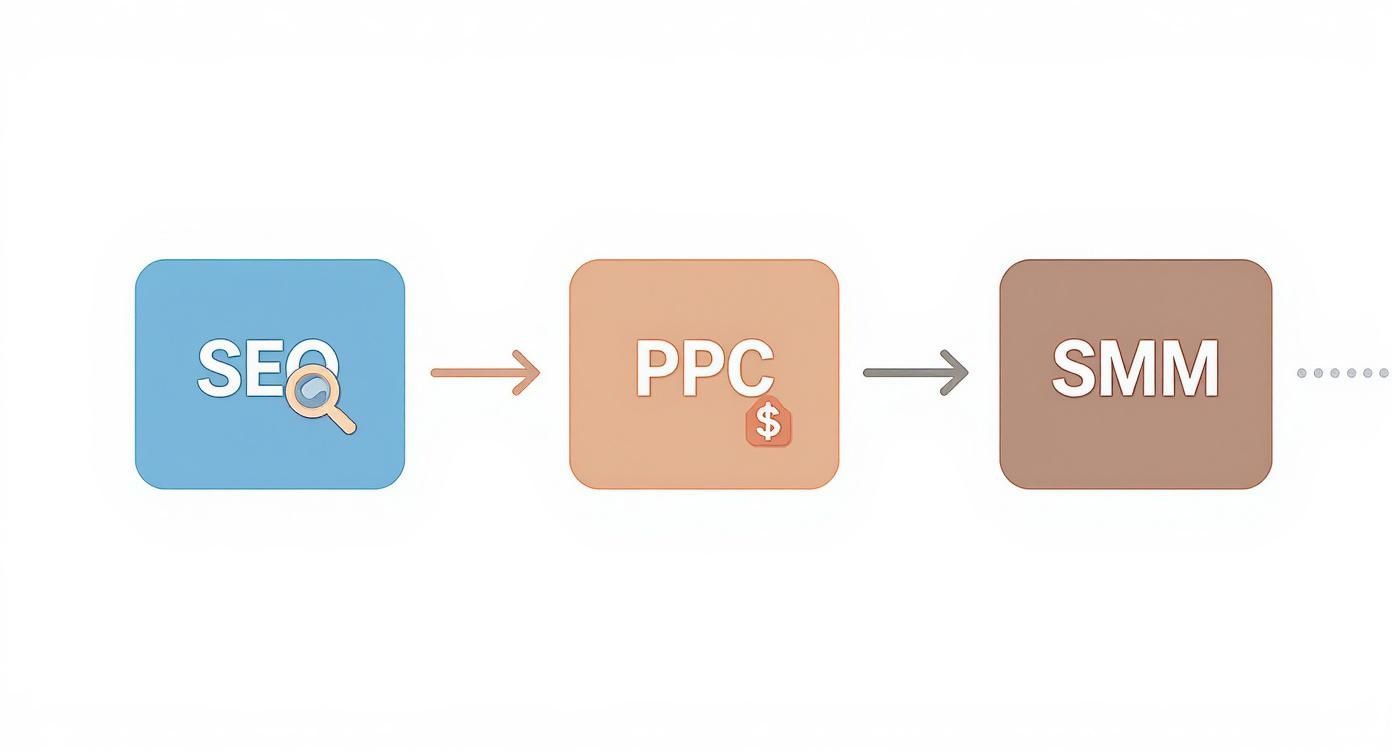
As you can see, each tool has its role, but the real magic happens when they work in sync as a single mechanism.
Step 4: Launch and daily operations
After signing the contract, the team rolls up its sleeves and starts bringing the strategy to life. This is the stage of daily, meticulous work: technical website optimization, content creation, configuration and launch of ad campaigns, and social media management.
The process is completely transparent to you. Each project is assigned a personal manager — your main point of contact. You can reach out at any time with a question and receive a comprehensive update on what’s happening with the project.
Step 5: Reporting, analysis, and optimization
Our work doesn’t end with campaign launches. In fact, that’s when the most interesting part begins. We regularly monitor key metrics and provide you with detailed, and most importantly, understandable reports. You’ll see not just pretty charts but concrete numbers: how many people came to the site, your customer acquisition cost (CAC), and what percentage of visitors made a purchase.
But the most important thing is what we do with these data. We constantly optimize campaigns: we switch off ineffective ads, reallocate budget to better-performing channels, and test new ideas. It’s a continuous cycle whose goal is to keep improving performance and maximize your return on investment (ROI).
How to choose a reliable internet marketing agency
Choosing a partner to promote your business online is like choosing an architect for your dream home. A mistake can cost not only money but precious time. To avoid this, you should approach the process thoughtfully, evaluating a potential internet marketing agency by clear, understandable criteria.
It’s not just about finding a contractor. It’s about selecting a strategic partner who will dive deep into your business. Let’s go over the key points that will help you make the right decision.
Portfolio and case study analysis
The first and most obvious step is to study the agency’s experience. But don’t just glance at famous logos. Dig deeper to see whether the team has relevant experience in your niche or with similar business tasks.
What to look for:
- Concrete results. A good case study isn’t just “we did SEO.” It includes hard numbers: the initial problem, the strategy used, and how it impacted key business KPIs — traffic growth, number of leads, customer acquisition cost (CAC), and return on investment (ROI).
- Project similarity. If you sell furniture, a case about promoting a mobile app is less indicative than a successful project for another home goods e-commerce store. Seek similarities.
- Transparency. Is the agency willing to openly discuss the challenges they faced on a project and how they overcame them? This signals honesty and real professionalism.
The true value of a case study isn’t the big client name but the detailed path from point “A” (the problem) to point “B” (a measurable outcome) with the logic of each step explained.
Reputation and reviews check
Testimonials on the agency’s website are fine, but they’ll always be perfect. To form an objective picture, you need to look for information on independent platforms: niche forums, social media, and specialized ratings sites.
Don’t hesitate to ask for contacts of 1–2 current clients to get live feedback. If the agency has nothing to hide, they’ll gladly provide it. This is the best way to learn about real communication quality, adherence to deadlines, and overall service level.
Assessing the team’s expertise
In early meetings, pay attention not only to the sales manager but also to those who will work directly on your project. Who are these people? What is their experience? Do they understand the specifics of your business?
Don’t be shy to ask concrete questions about their approach. For example, ask where they would start with your site. A professional’s answer will always be based on analysis and data, not generalities. A competent team will never propose a cookie-cutter solution but will strive to develop an individual strategy. You can find more tips on evaluating a contractor in our guide on how to choose an SEO agency in Kyiv and achieve results.
Process and reporting transparency
A reliable internet marketing agency always works transparently. This means you should clearly understand several things:
- Where your budget goes. You should see what portion pays for the team’s work and what goes directly to ad channels.
- How effectiveness is measured. Reports must be understandable to you, not just to a marketer. They should include not just a set of metrics but an analysis of how those numbers affect your business goals.
- How communication works. Who is your account manager? How often will you receive reports and hold meetings? Well-established processes are a sign of a mature company.
The e-commerce market in Ukraine has enormous potential. Today, there are about 11 million active online shoppers in the country, making an average of 17 online purchases per year and spending about 1,300 hryvnias each time. At the same time, online retail penetration still significantly lags developed markets, creating great opportunities for growth. The key is choosing the right promotion partner.
Choosing the right contractor is the key to leveraging these opportunities effectively and not getting lost among competitors.
How much do agency services cost and how is the price set?
Let’s get straight to the point — money. This question concerns every business owner and is often shrouded in myths: “it’s definitely expensive,” “prices are pulled out of thin air,” “you never know what you’re paying for.”
In reality, everything is much simpler and more transparent. A professional marketing agency isn’t interested in sending you a sky-high invoice. Its goal is to offer a clear collaboration model that fits your budget and delivers real results. Let’s look at four main pricing approaches so you can confidently plan your marketing investments.
Fixed monthly fee (Retainer)
This is the most common option for long-term work. You pay a fixed amount each month and receive an agreed set of services or team hours. It’s ideal for areas like SEO promotion or content marketing, where results accumulate over time.
What are the advantages:
- Clear budgeting: You know your monthly costs exactly, which simplifies financial planning. No surprises.
- Deep immersion: The agency becomes your remote marketing department, thoroughly learning your product, market, and goals.
- Long-term focus: This format allows you to build a strategy months ahead and steadily pursue major goals.
You can compare this to a gym membership: you pay a fixed price and get access to all the “equipment” and the “trainer’s” expertise to achieve long-term results.
Project-based payment
Do you have a specific task with a clear end? For example, building a landing page, conducting an SEO audit, or launching a single ad campaign. Then project-based payment is your choice.
The cost, timelines, and expected outcome are fixed up front. You pay for a finished deliverable. This is a great option if you’re not ready for ongoing cooperation yet but need to quickly address a particular business need.
Hourly rate
The most flexible format. It suits small, targeted tasks, consultations, or projects where the scope is hard to foresee right away. You pay for the actual time specialists spend.
An hourly model is ideal when you need competitor analysis, strategy consulting, or quick site edits. The key is that the agency tracks time precisely and provides transparent reports.
Although this approach may seem less predictable, it provides maximum freedom. Just agree on an approximate number of hours to avoid surprises on the invoice.
Performance-based payment
Sounds the most attractive, doesn’t it? The agency gets paid only for achieving specific KPIs: a percentage of sales generated by ads or a fixed amount per qualified lead.
This model requires absolute trust and transparency because the agency needs access to your sales analytics. It works best in niches with high margins and a clear customer journey, such as e-commerce.
Which model suits you best? It depends on your goals, budget, and stage of business. A good internet marketing agency like Moveiton will always help you choose the optimal option that benefits both sides and is aimed at real business growth.
What business growth with an agency looks like in practice
Theory is good, but real numbers speak best about the value of an internet marketing agency’s work. Let’s look at concrete examples to see how a properly built strategy turns into real revenue. These are anonymized cases, but each reflects a true growth story.
Case 1: Online store for children’s goods
Problem: The store owner found themselves in a familiar situation. Competition was off the charts, ad clicks were “golden,” and organic traffic barely survived. The site got lost among market giants, and sales scarcely covered costs.
Strategy: We deployed a comprehensive program led by SEO and content marketing. Instead of fighting for the most popular queries, we focused on lower-volume but much more precise phrases entered by users already ready to buy. We performed deep technical optimization, launched a helpful blog with parenting tips, and squeezed the maximum from every product page.
Results:
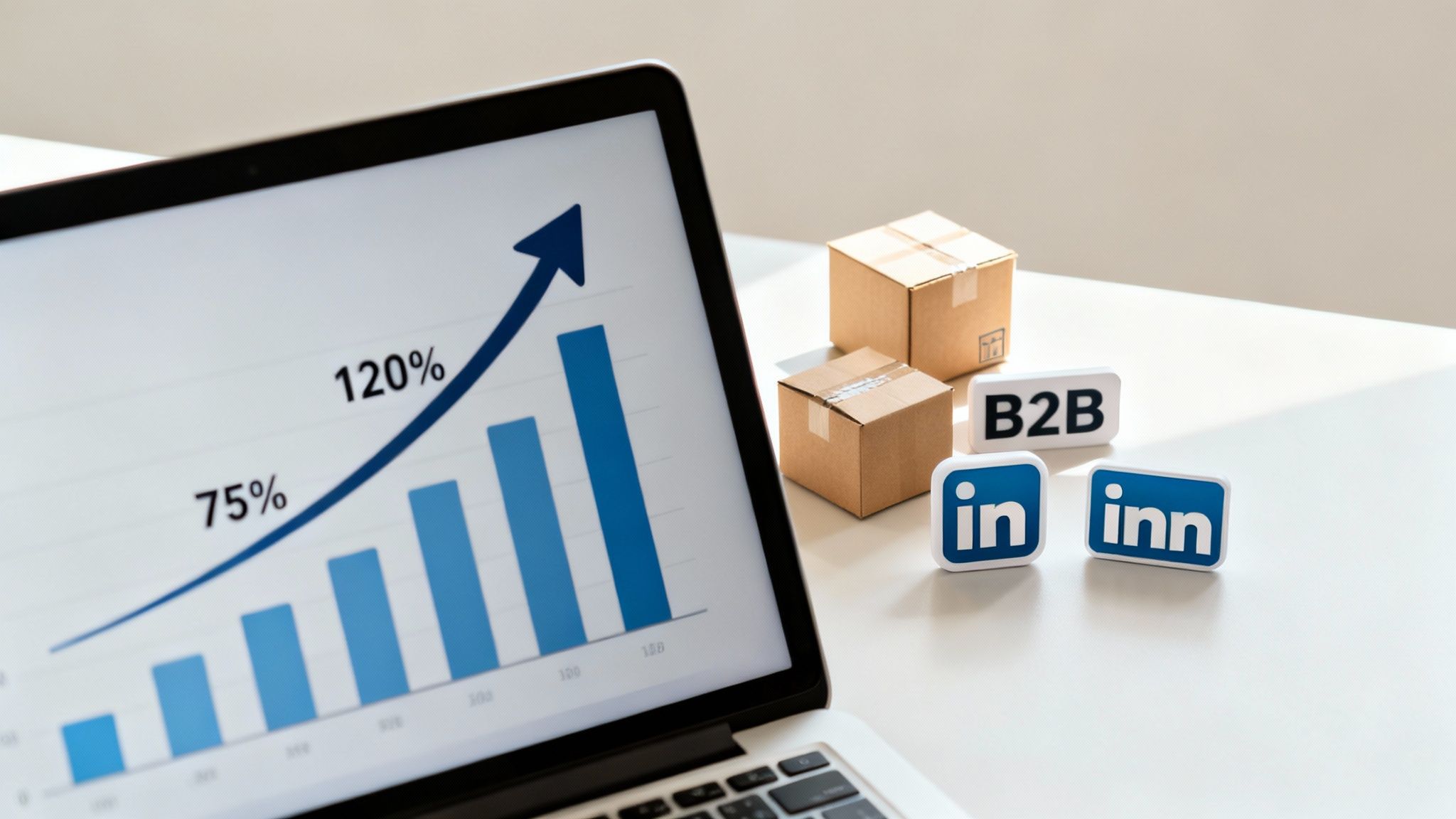
- In the first six months, organic traffic from search engines increased by 120%.
- Thanks to a flow of “warm” audiences, customer acquisition cost (CAC) fell by 45%.
- Overall online sales grew by 75%, fundamentally improving the business economics.
This example shows that systematic work on SEO and content is a powerful investment that pays off for years.
Case 2: B2B logistics company
Problem: The company offered high-quality but expensive logistics solutions for large enterprises. Classic tools like Google Ads barely worked. Decisions here are made by top managers, who aren’t easily “caught” by a regular banner.
In the B2B segment, the key task is not just to drive traffic but to reach specific decision-makers. You need surgical precision, not carpet bombing.
Strategy: Our main weapons were targeted LinkedIn ads and well-thought-out email campaigns. We prepared several detailed case studies and analytical reports (so-called lead magnets) offered in exchange for contact information. Then a series of emails “warmed up” prospects, demonstrating the company’s expertise and reliability.
Results: In three months, we generated 40+ qualified leads — i.e., inquiries from target companies. For such a narrow niche, that’s an outstanding result. The cost per lead turned out to be three times lower than expected, and 5 of them became large, long-term contracts.
Such success stories are not coincidences but the result of systematic work. You can see more examples in our portfolio.
Today, Ukraine is a huge digital market. The number of internet users has reached 31.5 million, which is 82.4% of the population, and 21.6 million Ukrainians actively use social networks. These numbers prove one thing: your audience is definitely online, and a professional agency knows how to find and engage it.
Answers to common questions about working with an agency
Starting cooperation with a marketing contractor, especially for the first time, always raises many questions. And that’s normal. We’ve collected the ones we hear most often and are ready to give honest, comprehensive answers. We hope this helps dispel doubts and clarify what to really expect when working with an internet marketing agency.
When will we see the first results?
Probably the number one question. The short answer: it depends on the tools we choose.
- Pay-Per-Click (PPC): Things move fast here. The first site visitors, and sometimes the first orders, can appear on the day the campaign launches. It’s the quickest way to get traffic.
- SEO promotion: A completely different story. SEO is a marathon, not a sprint. The first noticeable improvements in rankings and organic traffic are usually seen after 3–6 months of consistent work. It’s a long-term play and an investment in your business’s stable future.
It’s important to remember: quick results aren’t always stable. PPC works as long as you fund it. High-quality SEO builds an asset that will keep bringing customers long after the main work is done.
Why can’t you guarantee a specific number of sales?
This is fundamental. No professional agency that respects itself and its clients will promise you X sales or Y profit. Not because we lack confidence in our work, but because that would be dishonest.
Our area of responsibility is to bring high-quality, targeted traffic to your site. We guarantee ranking growth, an increase in relevant visitors, and efficient budget use. However, final sales are influenced by factors we don’t control: how competitive your pricing is, product quality, your team’s lead handling speed, and overall service level.
Simply put, we will bring interested people to you. Turning them into happy customers is joint work, where your business plays the key role.
What if my budget is small? Can we still work together?
Of course. A limited budget isn’t a verdict; it’s a reason for smarter planning. The key is not to “spread” a small sum across all possible channels at once. That’s the most common mistake.
Instead, focus on 1–2 areas that will deliver the fastest and clearest results for your niche. For example, start by configuring PPC for your most profitable products. This lets you quickly generate initial revenue to reinvest in other, longer-term channels like SEO.
Which metrics should I watch to know things are going well?
At the start, it’s easy to drown in a sea of metrics and reports. To avoid this, we recommend focusing on three key indicators that show marketing effectiveness without embellishments.
- Customer Acquisition Cost (CAC): How much, on average, you spend to acquire a single new customer.
- Lead volume and quality: Not just how many requests you received but how many were truly qualified.
- Return on Ad Spend (ROAS): The most important indicator. How many units of revenue each unit of ad spend generates.
These simple numbers give you a clear view of whether you’re making money or just spending the budget.
We hope these answers clarified the picture. If you’re ready for systematic business growth and looking for a reliable partner, the Moveiton team will be happy to provide a free consultation and craft a strategy tailored to your specific goals.