
 Telegram

Online advertising is like your own loudspeaker — not the one that shouts across the square at everyone, but the one that whispers your offer right into the ear of an interested person. Unlike traditional methods, it lets you communicate precisely with people already searching for your product or service, turning your ad budget into a fully measurable investment in business growth.
What online advertising is and why your business needs it
Think of a classic billboard on a busy avenue. Thousands see it daily, but how many are your potential customers? Maybe a few. Yet you pay for impressions to everyone, hoping someone will respond. That’s the old school — and it’s working worse and worse.
Now picture this. You show an ad to someone at the very second they google “buy a baby stroller in Kyiv.” Or you reach a woman aged 25–35 who’s into yoga and healthy eating right in her Instagram feed. That’s the core power of online advertising.
From “budget drain” to managed investments
The key difference with digital ads is that you pay not for abstract impressions but for specific, countable actions. This makes marketing transparent, understandable, and controllable.
Here are the main advantages:
- Precise targeting: Show ads to very narrow groups by age, gender, location, interests, online behavior, and even income level.
- Measurability: Every hryvnia invested is tracked. You clearly see how many clicked the ad, how many visited your site, and how many ultimately placed an order.
- Flexibility: Analytics enable instant reactions. If a campaign underperforms, you can pause it, change creatives, retune audience settings, or reallocate budget — all in a few clicks.
In online ads, even small businesses with modest budgets can compete with giants on equal footing. Winners aren’t those with the fattest wallets, but those who best understand their customers and tune campaigns more precisely.
What it looks like in practice
Imagine you opened a small coffee shop in Lviv. Instead of handing out flyers, you launch Instagram Stories ads. People who are within a 1 km radius right now, love coffee and desserts, and look for cozy spots will see your ad. The chances they’ll pop in for a cappuccino are much higher, right?
This approach turns marketing from guesswork into a clear, data-driven process. You stop guessing and start making informed decisions. The ability to control, analyze, and optimize spend is what makes online advertising indispensable for any business today.
Overview of key online ad channels
The digital ad world isn’t a single straight highway; it’s a network of roads — each leading to a different type of customer. To reach your goal via the shortest route, you need to know the map well. Let’s figure out which route fits your business.
Search advertising (PPC)
Say you sell outdoor gear, and right now someone searches for “buy a tent for mountain hiking.” Search ads let you appear right in front of them at that exact moment.
You’re not pushing a product; you’re offering a solution exactly when they’re looking for one. This is working with “hot” demand.
The payment model is PPC (Pay-Per-Click) — you pay only when someone clicks your ad and visits your site. For businesses needing sales here and now, professional Google Ads search campaign setup is one of the fastest ways to get results.
Targeted ads in social networks
If search ads capture demand, targeted social ads create it. They let you “meet” potential customers before they start actively searching. It’s like walking into a room where your exact audience is gathered.
Here you can target by hundreds of parameters:
- Demographics: age, gender, marital status.
- Geography: from an entire country down to a specific neighborhood.
- Interests: sports, fashion, technology, parenting.
- Behavior: frequent travelers, online shoppers, or those who recently visited your site (retargeting).
This makes social platforms like Facebook and Instagram ideal for making yourself known, promoting new products, and building long-term relationships.
The infographic below highlights the core benefits of online ads: precision, measurability, and effectiveness.
Each point underscores that you fully control the process and can optimize campaigns to maximize return on every invested hryvnia.
Video and display advertising
Want not just to tell, but to show and engage? Video is your best tool. It appeals to emotions and lets you tell a complete story about your brand or product. Platforms like YouTube offer massive reach in a dynamic, engaging format.
Video’s potential in Ukraine is huge. In early 2025, YouTube’s ad reach was 21.6 million Ukrainian users — that’s 56.4% of the entire population! The numbers speak for themselves: video is one of the largest promotion channels.
Display (banner) ads work a bit differently. These are the graphical ads you see on news sites, blogs, and niche portals. Their main goal is visibility and brand awareness — so when a customer needs your product, your company comes to mind first.
To make it easier to navigate, here’s a brief comparison table.
Comparison of popular online ad channels
This table helps you quickly compare major channels by key parameters: best use cases, payment models, and core advantages for business.
| Channel | Best for | Payment model | Key advantage |
|---|---|---|---|
| Search ads (PPC) | Quick sales, capturing “hot” demand | PPC (pay per click) | Reaching users already ready to buy |
| Targeted social ads | Brand awareness, demand generation | CPM (impressions), PPC | Precise audience targeting by interests |
| Video ads | Emotional engagement, brand storytelling | CPV (per view), CPM | Wide reach and strong visual impact |
| Display (banner) ads | Brand awareness, retargeting | CPM (impressions) | Broad visual reach across sites |
As you can see, there’s no “single right” channel. Each is a tool for specific jobs. The best results usually come from a smart mix — the foundation of a successful digital strategy.
How to choose the right ad channels for your business
Choosing an ad channel is like choosing a tool for a repair. A hammer is great for nails, but not for screws. Same in marketing: Google Ads is ideal for some jobs, Instagram for entirely different ones. To avoid blind budget drain, base decisions on three pillars.
This approach turns chaotic attempts into a clear, measurable strategy. Instead of being “a bit everywhere,” you focus where returns will be maximal.
Step 1. Analyze your target audience
The first and most important question: where do your customers spend time online? This is the foundation of your entire online ad strategy. There’s no point placing ads where the right person will never see them.
To figure this out, answer a few questions:
- Who is your customer? Build a detailed profile: age, gender, profession, interests, location.
- How do they search for information? If they urgently need a plumber, they’ll likely go to Google. If they seek interior design inspiration — Instagram or Pinterest.
- Which social networks do they use? Younger audiences gravitate to TikTok and Instagram; business audiences prefer Facebook and LinkedIn.
For example, if you sell complex B2B equipment, your audience is engineers and production managers. Entertainment content isn’t the place to find them. Targeting by job titles on LinkedIn or advertising on niche websites will work much better.
Step 2. Define your business goals
What exactly do you want from advertising? The answer directly affects channel selection and the metrics you’ll use to measure success. Broadly, goals fall into three groups.
- Sales and leads. If the goal is orders or inquiries here and now, choose channels for “hot” demand. Primarily that’s search online advertising via Google Ads shown to people actively seeking your product or service.
- Brand awareness. Want to reach as wide yet relevant an audience as possible? Social networks (Facebook, Instagram), YouTube video, and display campaigns are ideal. You’re not selling head-on; you’re building brand image and trust.
- Engagement and return. Want to bring back those who already showed interest or build a community? Use retargeting across social and search, plus content marketing.
The biggest mistake is demanding instant sales from a channel designed for awareness. That’s like expecting a marriage proposal at the first meeting. Each channel has its role in the customer journey.
Step 3. Assess your budget and resources
Your financial capacity directly affects your choices. Some channels require substantial investment to see noticeable results; others let you start small.
For instance, video production for YouTube can be costly, while targeted Instagram ads with a few solid creatives can be launched on a minimal budget.
Also note that some tools — like SEO — while not direct ads, require time and continuous work. Long term, they can yield more stable and cheaper results. Learn more in our article on what SEO is and how it works.
Let’s break it down with concrete examples.
- Online clothing store: Goal — sales. Audience — young people on Instagram. Medium budget. Solution: Google Shopping for “hot” queries and Instagram targeted ads for visual presentation.
- Local coffee shop: Goal — foot traffic. Audience — people living or working nearby. Small budget. Solution: Instagram and Facebook geotargeting within a 1–2 km radius.
- B2B company (CRM systems): Goal — leads (demo requests). Audience — business owners and executives. Large budget. Solution: Google search ads on intent keywords and LinkedIn ads targeted by job titles.
Remember, choosing channels isn’t a one-off decision but an ongoing process. Analyze, test, optimize. Start with 1–2 obvious channels, measure results, and expand based on real data — not assumptions.
Budget planning and forecasting
“How much do we need to spend on ads?” is often the first question entrepreneurs ask. Many answer: “I’ll set aside an amount I can afford to lose.” That’s more like roulette than a thought-out strategy.
Proper planning turns your ad budget from a vague expense line into a powerful growth tool. So don’t start with “How much to spend?” but with “What result do I want?” That shift takes you from abstract numbers to a clear, justified plan.
How to calculate a starting budget
Suppose your goal is to acquire the first 100 customers via online advertising. First, find your niche’s average cost per click (CPC). You can estimate it with Google’s Keyword Planner or market analysis.
Assume average CPC is UAH 15. Next, estimate your site’s conversion rate — the percentage of visitors who become buyers. For a new project, a market-average 1–2% is reasonable.
Now a bit of simple math:
- To get 1 sale (at 1% conversion), you need 100 visitors.
- Cost to get 100 visitors: 100 clicks × UAH 15/click = UAH 1,500.
- Therefore, cost of acquiring one customer (CAC) is about UAH 1,500.
Thus, to reach 100 customers, you’d need around UAH 150,000 (100 × 1,500). Of course, that’s a starting estimate — a realistic baseline for planning.
Key profitability metrics
Knowing CAC is only half the story. To see if your ads are profitable, compare it to how much revenue a customer brings over time. Two more metrics help here.
- LTV (Lifetime Value). The total revenue from one customer over your entire relationship.
- ROAS (Return on Ad Spend). How many hryvnias of revenue you get for each hryvnia invested in ads.
There’s a golden rule: your LTV should significantly exceed CAC — ideally by a factor of 3 or more. If acquisition costs exceed what a customer brings, the model won’t sustain.
Example: if a typical customer makes 3 purchases of UAH 2,000 each, LTV is UAH 6,000. With CAC of UAH 1,500, you not only recoup acquisition but generate solid profit.
This mindset reframes budget as an investment with forecastable returns. It’s especially relevant in Ukraine’s resilient market. The country’s digital ad market exceeded UAH 41.3B in 2024, with 2025 projected to grow by nearly 29% — to UAH 51.9–53.2B. The strongest growth comes from search (+40%) and SMM (+50%), showing businesses are ready to invest in measurable channels. Read more about these market trends on marketer.ua.
This trajectory confirms: smart online ad investments remain key growth drivers in today’s Ukrainian realities.
How to measure online ad effectiveness
Running ads without analyzing results is like driving blindfolded. You press the gas (spend money) without knowing whether you’re heading toward your goal or off a cliff. Measurement turns chaos into a controllable process where each decision rests on real data.
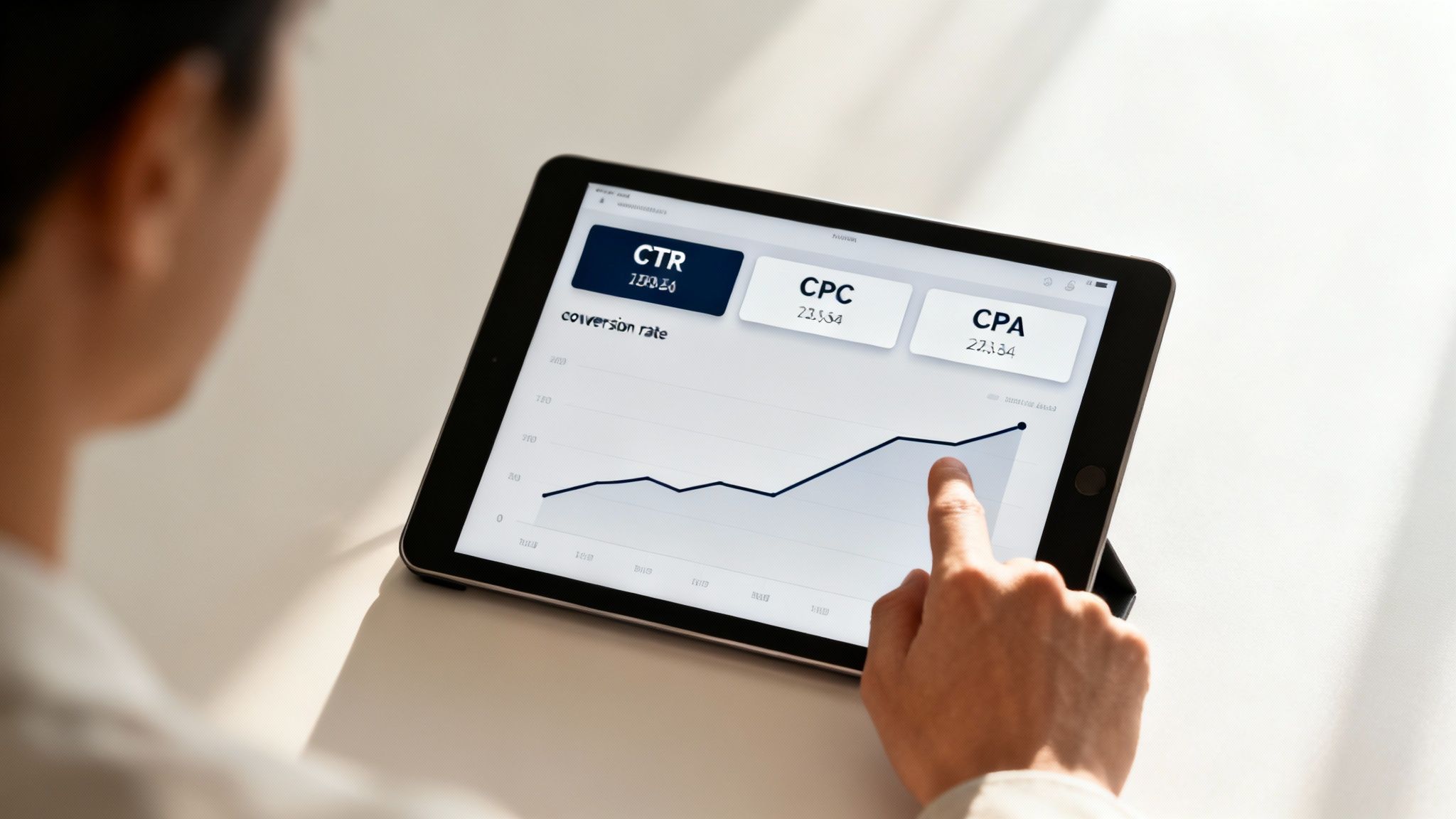
The foundation of any analysis is a properly configured analytics stack, typically Google Analytics. It’s essentially your eyes for understanding post-click behavior. Without it, you won’t know which campaigns make money and which just burn budget.
Core success metrics
To avoid drowning in numbers, focus on key KPIs that reflect your campaign’s “health.” Here are the essentials in plain terms:
- CTR (Click-Through Rate). The percentage of people who saw your ad and clicked it. A high CTR (e.g., 5–10% in search) signals relevant, compelling messaging.
- CPC (Cost Per Click). What you pay per visit. Helps control spend and identify which keywords or audiences are more economical.
- CPA (Cost Per Action). What one inquiry, registration, or call costs you — the real price of achieving a business goal.
- Conversion Rate (CR). The share of visitors who complete the desired action (e.g., purchase). CR shows how efficiently your site turns traffic into customers. See our detailed article on what conversion is and how to increase it.
These metrics are interrelated: low CTR can raise CPC, and a weak CR inflates CPA.
The primary profitability metric
Even if other metrics look great, one metric answers the core business question: “Are we making money?”
ROAS (Return on Ad Spend). How many hryvnias of revenue you get per hryvnia invested. If ROAS is 500%, every hryvnia returned five.
ROAS gauges overall financial success. By analyzing it, you can shift budget to the most profitable channels and creatives, turning online advertising into a predictable scaling lever.
In Ukraine, paid search grew by 30% in 2024 to UAH 20.23B, with 2025 projected to rise another 40%. This underscores business reliance on measurable channels.
Regular KPI reviews, identifying weak links, and constant optimization — that’s the recipe for successful campaigns. It’s an endless “measure — analyze — improve” loop that drives consistently strong results.
Real online advertising case studies from Ukraine
Theory is great, but practice explains best. To show how online advertising works in Ukraine, here are a few success stories from Moveiton’s portfolio — proof that smart strategy turns ad budgets into real profit.

Each case is unique, backed by thorough analytics: deep dives into the client’s business, audience, and competitors. That’s how we find the shortest path to goals.
Case 1: Furniture manufacturer
Problem: A local designer-furniture maker had stagnant online sales. The site drew few visitors; most orders came via the physical showroom and word of mouth, stalling growth.
Solution: A two-pronged strategy:
- Google Shopping: We launched product listings so searches like “buy oak table” displayed images, prices, and product names — capturing “hot” intent.
- Facebook and Instagram remarketing: We “followed up” with site visitors who viewed products but didn’t buy, showing them those exact items again (sometimes with a small incentive).
Result: Within three months, online orders grew by 150%. Effective remarketing also cut CAC by 40%.
Case 2: Education project
Problem: An online school aimed to pack a free intro webinar for a new course. The target audience — young professionals active on social media.
Solution: We focused spend on Instagram ads. First, we segmented by interests (marketing, IT, design), roles, and age. Then we built several vivid, dynamic creatives for Stories and Feed, leading to a simple signup form.
Daily optimization was crucial. We continually tracked which ads and audiences delivered the lowest-cost registrations and reallocated budget instantly.
Result: Two weeks of active ads brought over 5,000 registrations. The average cost per registration ended up 25% lower than planned — more leads for the same money.
These examples show that successful online advertising isn’t magic but the outcome of clear strategy, constant analysis, and agile iteration. Every business has its path to the customer’s heart; our job is to find it and make it maximally efficient.
Frequently asked questions about online advertising
The online ad world can seem confusing, so we’ve gathered answers to the questions we hear most. We hope they dispel doubts and help you take confident first steps.
When to expect first results?
It depends on the channel. Google search ads can deliver calls and orders within days because you’re tapping “hot” demand — people actively looking for your product or service.
With targeted social ads, timelines are longer — typically a week to a month. You’ll need to experiment with creatives, audiences, and messages to find the best mix. Long-term plays like SEO deliver stable results only after 4–6 months of consistent work.
Can I set up ads myself?
Yes. Modern platforms like Google Ads and Facebook Ads Manager have fairly intuitive UIs. For small budgets or a test run, that may suffice. But online advertising is more than pressing “Promote.”
Real effectiveness lies in the details: deep audience analysis, sound strategy, constant hypothesis testing, and data-driven optimization. Without experience, it’s easy to make mistakes that just burn budget.
Common mistakes beginners make?
Most stumble over the same issues — costing money, time, and lost opportunities.
Top three mistakes:
- No clear goal. Running ads “to get sales” leads nowhere. Set specific, measurable goals, e.g., 50 inquiries with CPA ≤ UAH 200.
- Ignoring analytics. Without tracking (CTR, CPA, ROAS), you act blindly. You can’t tell what works vs. wastes money.
- Audience too broad. Trying to reach “everyone” means reaching no one. The more precise the targeting, the higher the return per hryvnia.
How to tell ads aren’t working?
Watch for these red flags; if you see any, pause, analyze, and adjust.
- Low CTR. People see your ads but rarely click — likely irrelevant or unappealing.
- High CPC and CPA. Acquisition costs are so high they don’t pay off.
- Few conversions. Traffic arrives but doesn’t act — an issue with the landing page or offer is likely.
Understanding these nuances helps you manage ad investments more effectively and avoid common traps.
Ready to turn knowledge into real results? The Moveiton web studio team will help develop and launch an effective ad strategy that brings customers and grows profit. Book a free consultation at moveiton.net and start growing today.