
 Telegram

Imagine your offer appearing before someone’s eyes exactly at the moment they’re actively searching for your product or service. That’s the magic of website contextual advertising — a powerful tool that instantly grabs the attention of a “hot” audience, and you pay only when someone actually clicks through to your site.
How is contextual advertising different from SEO promotion?
This is arguably the key question that defines the entire marketing strategy. Put simply, contextual advertising (PPC) is a sprint, while SEO is a marathon.
Think of PPC as renting a giant billboard on Khreshchatyk. You pay — and thousands of people immediately see your ad. But as soon as the money runs out, the billboard comes down. The same applies here: you get fast, controllable traffic, but it exists only while you pay for it. Ideal for flash sales, launch promotions, or testing a new product.
SEO, on the other hand, is like building your own store on the same street. The process is lengthy and requires serious investment in the “foundation” and “walls” (content, technical optimization, links), and the first visitors won’t appear for several months. But once construction is complete, you get a stable flow of customers (organic traffic) without paying for each visit. SEO is a long game that builds an asset and trust in your brand.
The key difference lies in speed and payment model. PPC delivers results here and now for money. SEO works for the future, providing conditionally free traffic but requiring time and patience.
Main differences in practice
Let’s break down the key points so the difference is crystal clear:
- Speed: PPC brings visitors within hours of launch. SEO requires 3 to 12 months to reach notable positions.
- Cost: In contextual ads you pay for each click. With SEO you invest in specialists’ work, content creation, and links — but organic clicks are free for you.
- Control: PPC gives full control. You manage budget, targeting, and ad copy, and can make changes on the fly. SEO is less predictable and heavily depends on search engine algorithms.
Here’s how it looks in practice. The first results marked “Ad” are contextual advertising in action.
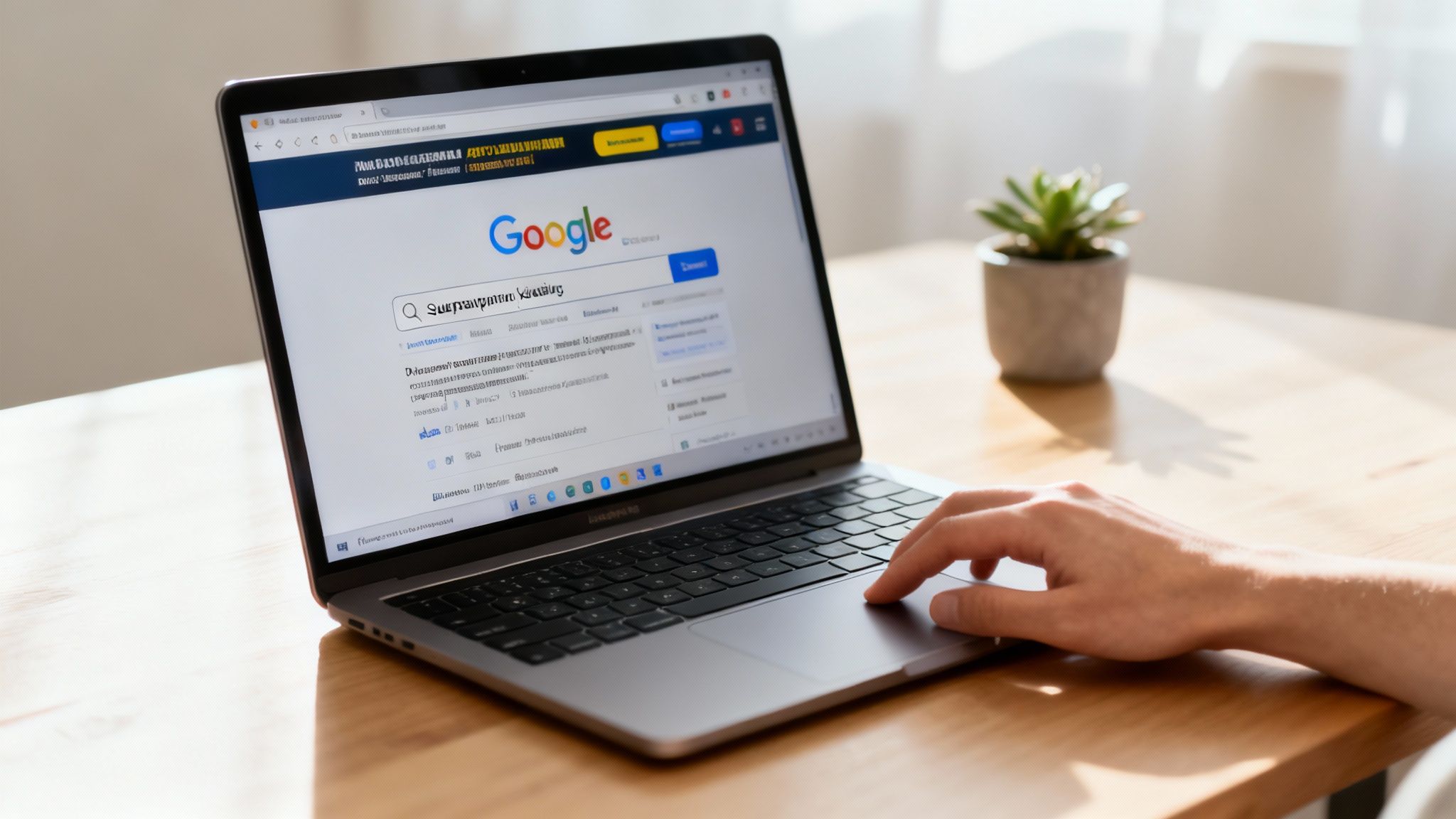
As you can see, paid ads occupy the most prominent spots, guaranteed to catch the eye of those already ready to buy.
Ukrainian market trends only confirm how important both directions are. Back in 2021, digital advertising took the lead with over 50% of total ad budgets. Moreover, website contextual ads showed an impressive 42% growth. This indicates how quickly businesses recognized the tool’s effectiveness. Learn more about the market’s evolution in the study on ain.ua.
At our Moveiton web studio, we help clients get the most out of this tool. The cost of setup and management starts at $400 per month, with the ad budget paid separately by the client. This ensures full cost transparency.
Contextual ads or SEO: what should your business choose?
Choosing between contextual advertising and SEO is not just a tactical decision — it’s a fundamental strategic one. It determines how quickly and by what means your business will start winning customers online. These two tools are often confused, though they operate on very different principles. If we compare them to sports, it’s a sprinter and a marathoner running toward the same finish line — traffic acquisition.
Imagine contextual advertising (PPC) as a rented sports car. You pay, get behind the wheel, and instantly speed toward your goal. Ads appear at the top of Google almost immediately after launch, bringing initial visitors and potential sales. But once you stop paying for fuel (i.e., the ad budget), the ride ends.
SEO promotion, by contrast, is like building your own reliable car from scratch. It’s a long process requiring time, effort, and investment in quality “materials” (content, technical optimization, links). Results don’t appear immediately — sometimes it takes months. But once the car is ready, it’s yours to keep and brings customers consistently, requiring only maintenance.
Key differences: speed, cost, control
The main difference lies in the speed of results and the payment model. PPC can deliver first clicks and conversions the day you launch. This makes it ideal for a quick start, testing business hypotheses, or promoting seasonal offers.
SEO, by contrast, is the long game. Search engines need time to index site changes, assess your authority, and rank you higher. Meaningful organic results typically appear in 3–6 months, while reaching the top in competitive niches may take a year or more.
The choice between PPC and SEO always depends on your business goals. Need sales “yesterday”? Choose contextual ads. Building a brand for years ahead and aiming for stable client flow? Invest in SEO.
Costs are also very different. With PPC, you pay per click, and prices can vary widely depending on competition. With SEO, you invest in specialists’ work — but the organic clicks themselves are free. We discuss the advantages of long-term investment in our SEO promotion guide.
Flexibility vs. stability
Contextual ads give you absolute control. At any moment you can:
- Adjust daily or monthly budgets.
- Edit ad copy to test new offers.
- Pause or launch campaigns instantly.
- Precisely target audiences by age, interests, or location.
SEO is far less predictable. You depend on Google’s constantly changing algorithms. Rankings can fluctuate, and you can’t guarantee the top spot forever. However, once you achieve strong organic rankings, you get stable and, importantly, more trusted traffic. Many studies confirm users trust organic results more than ads.
To better understand the difference, let’s look at a table.
Comparison of contextual ads (PPC) and SEO promotion
This table illustrates the key differences between the two approaches to driving website traffic.
| Criterion | Contextual ads (PPC) | SEO promotion |
|---|---|---|
| Speed of results | Instant (hours) | Long-term (months) |
| Cost | Pay per click | Investments in work and content |
| Traffic stability | Depends on budget | High after reaching the top |
| Control | Full and flexible | Limited, algorithm-dependent |
| Audience trust | Medium | High |
As you can see, each tool has its strengths. Your choice depends on resources, timelines, and goals.
Not “or,” but “and”: combine for maximum effect
The best strategy isn’t choosing one — it’s using both in synergy. In fact, data from contextual ads can be a goldmine for SEO. You can quickly test which keywords drive the most conversions, then focus your SEO efforts on ranking for those terms organically.
Our Moveiton web studio helps businesses find that perfect balance. We offer professional campaign setup and management. Our contextual ad management starts at $400 per month (specialists’ fees), and the ad budget is paid separately directly to the ad platform. This ensures full cost transparency and keeps you in control.
Contextual ads or SEO promotion: which to choose?
Choosing between the two giants of digital marketing — contextual ads and SEO — often leaves business owners at an impasse. It’s not just a technical question but a strategic one. It determines how quickly you’ll see your first customers and how stable that flow will be in the future. To choose wisely, you need to understand the fundamentals.
Imagine contextual advertising (PPC) as a sprint. You pay money and your ads almost instantly appear at the top of search results. The result — traffic, calls, orders — arrives practically immediately. It’s the perfect tool when you need sales “yesterday”: launching a new product, clearing seasonal stock, or quickly testing market demand.
SEO promotion, by contrast, is a marathon. It’s a long-term investment in your site that gradually builds trust with search engines and users. You don’t pay for each click, but you invest in quality content, technical optimization, and authority building. Results don’t arrive immediately — sometimes after months — but once at the top, you get a stable stream of organic traffic. And it won’t disappear as soon as you stop funding.
Speed vs. stability
The main difference is obvious: PPC provides immediate impact, while SEO is about the long term. If you’re launching an online store and want first orders this week, website contextual ads are essentially your only option. You can launch a campaign within hours and start attracting targeted traffic right away.
However, this traffic has a price and fully depends on your budget. Once payment stops, the visitor flow ends. SEO creates a compounding effect. Every article and technical improvement is another brick in the foundation of your long-term search visibility.
PPC is renting audience attention. SEO is investing in your own online real estate. The former yields fast results; the latter brings stability and long-term value.
To visualize this, look at the infographic highlighting key differences between PPC and SEO across three main criteria.

As we can see, PPC clearly wins on speed, but SEO delivers a more sustainable, longer-term result.
Flexibility and control
Contextual ads give you near-total control. You can:
- Make instant changes: test different ad copies, swap landing pages, or adjust bids in real time.
- Target precisely: focus on users by location, age, interests, time of day, or even device.
- Manage budgets: set daily spend limits and pause or resume campaigns anytime.
SEO is trickier. It’s less flexible and depends heavily on ever-changing search algorithms. You can’t guarantee the top spot, and site changes may take weeks to index.
How much does it cost?
PPC has a simple model: you pay per click (Pay-Per-Click). Cost per click (CPC) may range from a few to hundreds of hryvnias depending on niche competition. These are direct, predictable expenses.
With SEO, you don’t pay for clicks but invest in specialists — SEOs, copywriters, link builders. It’s an investment in an asset whose value grows over time. While SEO may seem more expensive upfront, over the long run the customer acquisition cost (CAC) from organic search is often much lower.
Synergy of PPC and SEO: the best strategy
The most effective approach is to combine both channels. Data gathered from contextual ads can significantly strengthen your SEO strategy.
For instance, a PPC campaign can show within days which keywords convert best. Then you can focus SEO efforts on ranking for those high-converting terms organically. This lets you make decisions based on real data rather than assumptions.
In 2025, Ukraine’s overall advertising and communications market is steadily recovering, with digital as the main growth driver. Forecasts show its share reaching 62.7% of the entire market. Contextual ads play a key role due to their flexibility and agility in changing conditions — making them indispensable for business. See more in the updated forecasts by the All-Ukrainian Advertising Coalition.
At Moveiton, we help businesses find the optimal balance between PPC speed and SEO stability. Our contextual ad management starts at $400 per month — this is the fee for our specialists’ work. The ad budget is paid separately directly to Google, ensuring full transparency and control over your spend.
If you’re ready to get your first customers as soon as tomorrow, learn more about our Google Ads setup service.
Analysis and optimization for better ROI
Launching a campaign is only half the job. The real work that turns ad spend into profit begins with analytics. Without it, website contextual advertising is a lottery where you burn money. The goal here is to clearly see what works and what doesn’t — and direct budget where it returns the most.

The foundation of any optimization is accurate conversion tracking. You must see exactly which click on which keyword led to an order, a phone call, or a form submission. Without this data, you’re operating blindly.
Setting up conversion tracking
To collect accurate data, you need a reliable connection between your site, your Google Ads account, and your analytics system. Typically, two core tools are used: Google Analytics 4 (GA4) and Google Tag Manager (GTM).
- Google Analytics 4 is your command center for analyzing user behavior. Here you can see the full customer path: where they came from, which pages they viewed, and whether they completed a goal.
- Google Tag Manager is a convenient container for all tracking codes (tags). It lets you install and update them without involving a developer every time.
Once everything is set up, import GA4 goals directly into Google Ads. This lets the ad platform “see” which campaigns, ad groups, and keywords generate conversions. Based on this data, automated strategies can optimize bids for the best results. By the way, if you’d like to dive deeper into goals, check our detailed piece on what conversion is and how to realistically increase it.
Decoding the key metrics
Once data starts flowing, learn to “read” it correctly. Focus first on these core indicators:
- CTR (Click-Through Rate) — click-through rate. The percentage of people who clicked your ad after seeing it. A low CTR may signal weak ad copy or poorly chosen keywords.
- CPC (Cost Per Click) — the cost per click. How much each site visit costs. Keep it under control to avoid overspending.
- CPA (Cost Per Action) — cost per conversion. One of the most critical metrics, showing how much a lead (call, form) costs you.
- ROAS (Return On Advertising Spend) — advertising return. How many units of revenue you get for each unit of ad spend. For example, ROAS 500% means every dollar invested returned five.
Always analyze these metrics in context. For instance, a high CTR but low conversion rate may point to a weak landing page rather than a bad ad.
Practical optimization steps
Armed with data, move to concrete actions. Remember, optimization is continuous testing and refinement.
A/B testing ads
Never rely on a single ad. Always create multiple versions with different headlines, copy, and CTAs. Google Ads will rotate and test them automatically, gradually favoring the version with the best CTR and conversion rate.
Search term analysis
Regularly check the “Search terms” report in Google Ads. It’s a treasure trove of insights showing real queries that triggered your ads. What to do with it?
- Grow your negative keyword list. Exclude irrelevant traffic to avoid wasting budget.
- Find new keywords. If a converting query isn’t on your list yet, add it.
Bid adjustments
Not all clicks are equal. Analyze performance by segments and adjust bids smartly:
- Devices: If mobile converts better, raise bids on mobile.
- Geography: Increase bids in regions with higher profitability.
- Time of day: If users are most active during the day, lower bids at night.
The power of remarketing
The stats are unforgiving: about 96% of visitors leave without buying. Remarketing is your chance to “catch up” and show personalized ads across other sites, YouTube, or Gmail. It’s among the most powerful tools to lift conversions because you reach a warm audience already familiar with your brand.
Ukraine’s contextual advertising market continues its rapid growth. According to the All-Ukrainian Advertising Coalition, paid search reached UAH 11.36 billion in H1 2025. Experts predict a further 40% increase by year-end. This underscores the importance of not merely being present in this channel, but managing investments effectively.
When to trust professionals with your ads
At a certain stage, running ads yourself is perfectly fine — especially with a small budget and the need to learn the basics. But as your business grows, stakes rise, and the cost of error becomes too high. Sooner or later, handing website contextual advertising over to specialists stops being a convenience and becomes a strategic decision.
Ask yourself honestly: Do you have time to monitor bids daily, analyze reports, and find growth points? Are campaigns generating the expected profit or just “eating” money? Do you know how to scale winners without losing ROI? If these questions give you pause, it may be time to bring in professionals.
Most companies don’t hire an agency because they can’t launch ads. They do it because their time spent growing the business is worth far more than hours spent inside an ad account.
What an agency actually does — and why it matters
A good PPC specialist doesn’t just “set up ads.” It’s a comprehensive process starting with deep immersion into your business and market, and it continues without pause.
Here are the core tasks the team handles:
- In-depth market and competitor analysis. Specialists study competitors’ strategies: which keywords they bid on, which creatives they use, and where their weak spots are. This reveals non-obvious opportunities and helps avoid known pitfalls.
- Professional toolset. Agencies use paid tools for analytics, keyword research, and monitoring (e.g., Serpstat, Ahrefs) that provide far more actionable data than standard tools.
- Ongoing optimization. Campaigns need daily attention: bid tuning, A/B testing creatives, pruning irrelevant queries, and managing negatives. It’s a continuous process most owners simply lack time for.
- Budget savings. Paradoxically, hiring an agency often saves money. Pros know how to cut waste, lower CPA, and increase ROAS without “pouring” money into ineffective clicks.
PPC and SEO: not competitors, but partners
Remember: contextual ads and SEO are different tools with different speeds.
PPC brings quick results, but they depend on budget. SEO is a long-term investment in organic traffic. PPC puts you on top for desired queries within a day. SEO takes months of consistent work to get there — but offers more stability.
The best approach is to use both together. PPC data — especially on high-converting keywords — is invaluable for building a winning SEO strategy.
Cost of professional services
At the Moveiton web studio, we work transparently. Every business is unique, so we offer flexible, goal-aligned terms.
Our setup and management for contextual ads starts at $400 per month.
This fee covers our certified specialists’ time, expertise, and pro tools. Importantly, the ad budget is paid separately directly to Google Ads. This guarantees 100% transparency: you always see what goes to clicks vs. agency fees. We provide detailed reports so you understand how each invested hryvnia works.
To wrap up this comprehensive guide, here are answers to several hot questions business owners ask most often. Hopefully, this helps dot the i’s and move forward confidently.
How does contextual advertising differ from SEO?
This is arguably the key question that defines your marketing strategy. In simple terms, contextual advertising (PPC) is a sprint, while SEO is a marathon.
Imagine PPC as renting a giant billboard on Khreshchatyk. You pay — and thousands see your ad immediately. But when the money runs out, the billboard comes down. Likewise, you get fast, controllable traffic, but only as long as you pay. Perfect for quick sales, promo launches, or testing new products.
SEO, conversely, is like building your own store on the same street. It’s long, requires serious investment in the “foundation” and “walls” (content, technical optimization, links), and the first visitors won’t show up for months. But once built, you get a steady stream of customers (organic traffic) without paying per visit. SEO is a long-term play that builds an asset and trust in your brand.
The key difference: speed and payment model. PPC delivers results now for money. SEO works long-term, providing conditionally free traffic, but requires time and patience.
How much does contextual advertising for a website cost?
Total cost always consists of two parts:
- Specialist or agency services. Payment for expertise, time, and work on setup and optimization.
- Ad budget. Money you pay directly to Google (or another platform) for each click on your ad.
The budget can range from a few thousand to six-figure amounts per month, depending on niche competition, geography, and how much traffic you want. For topics like device repair or legal services, CPC can easily reach tens or even hundreds of hryvnias.
As for service fees, at our Moveiton web studio we’re transparent. Our contextual ad management starts at $400 per month. That’s our expertise fee. The ad budget is paid separately directly in the ad account, giving you full control over spend.
Can I set up the ads myself?
Sure. Modern ad platforms like Google Ads offer user-friendly interfaces and plenty of automation. For a simple, small-budget campaign, that may be enough.
However, if you want not just to “run” ads but to maximize ROI and scale, experience is essential. A professional PPC specialist knows how to find “unobvious” keywords, write compelling ads, configure analytics correctly, and continuously optimize so you don’t waste money on irrelevant clicks. Often, investing in a pro pays for itself through savings.
I hope this guide was useful. If you’re ready to turn website contextual advertising into a powerful growth engine, the Moveiton team is at your service.
Contact us for a free consultation, and we’ll show you how to get your first customers as soon as tomorrow. Visit https://moveiton.net and submit a request