
 Telegram
Website promotion — is a marathon, not a sprint. It’s a comprehensive process that turns your site from a simple online business card into a powerful tool for attracting customers from search engines like Google. It’s not about some technical tricks, but about a core business process that generates sales and strengthens your brand.
Why website promotion — is the foundation for business
Imagine your website as a new store that has opened in a big city. Without a sign, without directions, without advertising... no one will notice it. SEO (search engine optimization) is the very navigation that brings interested buyers to you. When someone searches for «купити дитячий візок у Києві», Google instantly scans millions of pages to deliver the best answer. And SEO helps convince the search engine that the best answer — is your site.
The real value of top positions
Appearing on the first page of Google — isn’t just for prestige. It’s about trust and, ultimately, money. People subconsciously consider top-10 sites more reliable and authoritative. That’s simply a fact.
What does quality promotion deliver in practice?
- A steady stream of customers. Unlike paid search, which stops as soon as the budget runs out, organic traffic keeps coming for months or even years.
- High return on investment (ROI). In the long run, SEO often proves to be one of the most cost-effective customer acquisition channels.
- Increased brand trust. High search positions signal to the market that you’re among the leaders in your niche.
- Working with a «hot» audience. You get visitors who are already actively searching for your products or services. They’re ready to buy here and now.
Ignoring SEO today means voluntarily giving your customers to competitors. Properly formulated site search optimization goals become a clear roadmap that leads to real business outcomes.
Dynamics and continuous adaptation
The world of search engines doesn’t stand still. Google’s algorithms are updated constantly — and that’s no exaggeration. In just one year, there can be around 3200 changes, which is on average more than eight times a day! This pace means that approaches that worked yesterday may become ineffective tomorrow.
But those who know how to adapt achieve impressive results. For example, one Ukrainian portal, thanks to a flexible strategy and quick response to algorithm updates, managed to increase traffic by 82.3% in a year. To stay current, you should keep an eye on trends, for instance, explore how SEO has changed this year.
In essence, website promotion — isn’t a one-time setup but an ongoing dialogue. You conduct it simultaneously with the search engine and your audience. You need to continually analyze data, improve content and technical foundations to remain visible to your customers.
To better understand the structure of this process, let’s look at the main workstreams.
Main workstreams in website promotion
SEO — isn’t a single thing but a combination of several key components working together toward a common goal.
| Direction | Description | Key goal |
|---|---|---|
| Strategy | Market, competitor, and target audience analysis. Defining KPIs and developing an action plan. | Create a roadmap to achieve business goals. |
| Technical SEO | Optimizing code, load speed, mobile version, and site structure. | Ensure proper indexing and high site performance. |
| Content | Creating useful, unique, and relevant texts, articles, and descriptions. | Satisfy user queries and capture their attention. |
| Link building | Acquiring quality external links from authoritative resources. | Increase the site’s authority in the eyes of search engines. |
| Analytics | Tracking positions, traffic, conversions, and user behavior. | Evaluate effectiveness and adjust the strategy in time. |
Each of these areas is an integral part of successful promotion. You can’t, for example, write perfect copy but ignore technical errors — the result will be minimal. Only a comprehensive approach delivers stable and long-term effects.
How to develop an SEO strategy by analyzing competitors
Any successful website promotion starts not with on-site fixes or copywriting but with reconnaissance. Entering the market without understanding who your competitors are and how they operate is like setting off on a journey without a map. You can walk for a long time and still get nowhere. A strategy built on competitor analysis provides a clear action plan and helps avoid costly mistakes at the start.
Your main task isn’t to blindly copy leaders but to find their weaknesses and untapped opportunities. Those are your growth points.
Identifying your direct and indirect competitors
First, you need to understand who you’re competing with for user attention in search results. Competitors come in two types: direct (sell the same as you) and indirect (compete for the same keywords with a different product — for example, blogs, media, or aggregators).
To find them, you can use tools like Ahrefs or Semrush, or simply manually analyze Google’s top 10 for your main commercial queries. Compile a list of 5-10 key players — this will be your base for in-depth analysis.
The website promotion process can be conditionally divided into three key stages, which are well visualized in this infographic.
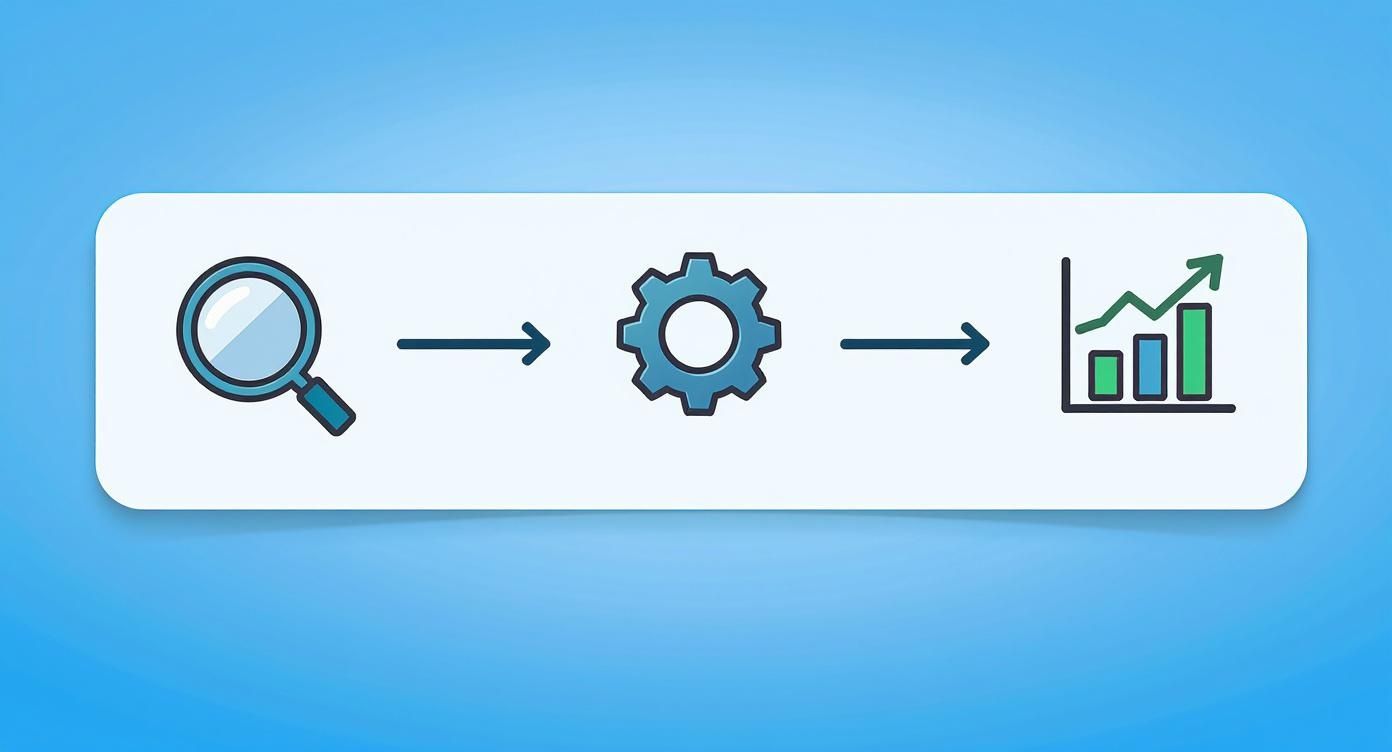
As we can see, analytics is the starting point that determines the direction of further optimization and directly affects the final result.
Diving into competitor strategy analysis
Once the list is ready, it’s time to dig deeper. You need to examine every aspect of their online presence, essentially breaking their marketing down to its molecules.
- Semantic core. Which keywords drive the most traffic to them? Look beyond commercial queries (buy, order, price) to informational ones (how to choose, review, top-10). Very often, it’s in informational content that «gaps» hide which you can easily fill.
- Content strategy. What content formats do they use? Product reviews, comparison pieces, case studies, videos? Assess the quality and completeness of the materials. Perhaps their articles are superficial, and you can offer much deeper and more useful content.
- Link profile. Who links to your competitors? Analyzing their backlinks is a real gold mine. This way, you can find quality platforms to place your links, for instance, through guest posts or outreach.
- Technical site condition. How fast do their sites load? Are they convenient on mobile? What does their URL structure look like? Competitors’ technical shortcomings are your direct advantage.
It’s important to understand: the goal of analysis is not to replicate someone else’s success but to find your unique path. If a competitor bets on video while your strength is in text, it may be better to focus on comprehensive long reads rather than trying to catch up on their turf.
This stage is part of a much larger process. To get the full picture, it’s worth learning what an SEO audit is and why it’s needed, since competitor analysis is just one of its key components.
Shaping your own strategy and setting KPIs
Based on the collected data, you can finally form your own strategy. For example, if you notice that competitors ignore long-tail queries, your strategy can focus precisely on them. Or if their sites are slow, your priority No. 1 will be technical optimization.
Once the direction is set, define key performance indicators (KPIs) to track progress and understand whether you’re moving the right way.
Here are the main KPIs for an SEO strategy:
- Growth in organic traffic. A target percentage or absolute number for a given period (e.g., +20% in 6 months).
- Positions for key queries. Tracking dynamics for the priority query pool.
- Number of leads/conversions from organic. This is the most important business metric showing the real return from promotion.
- Growth in site visibility. A metric reflecting how often your site appears in the results for target queries.
This approach turns website promotion from chaotic movements into a measurable and manageable process. Every step has a purpose and justification, which is the foundation that allows you to allocate resources effectively and achieve predictable results.
On-page optimization of your site
When the strategy is ready, the most interesting part begins — turning your site into a traffic-attracting machine. This is on-page optimization, or on-page SEO. You could say it’s the foundation on which all further website promotion rests. Without solid on-site work, even the best external links won’t deliver the results you expect.
This is meticulous work on content, code, and structure that essentially makes your resource clear to search robots and convenient for real people.

Start with the semantic core
Everything starts with collecting semantics — a complete list of queries your audience types in to find your products or services. It’s not just a set of words; it’s a real map of your potential customers’ needs.
It’s important to collect as many relevant keywords as possible, usually divided into three types:
- High-frequency: general phrases like «купити смартфон». They drive lots of traffic but face fierce competition.
- Mid-frequency: more specific, like «купити смартфон Samsung Київ». Competition is lower here, and the incoming audience is much "warmer".
- Low-frequency: very precise, long queries like «купити Samsung Galaxy S23 Ultra 256gb black ціна». Such keywords bring the most motivated buyers ready to convert.
Next, all collected queries must be properly grouped (clustered) and logically distributed across pages. Each page should correspond to its own keyword group. This helps avoid «cannibalization», where multiple pages fight each other for the same query, thereby weakening one another’s positions.
Optimizing meta tags and content
When keywords are distributed, it’s time to work on the Title and Description meta tags. These are your business card in search results, the first thing a user sees. They must be compelling and highly informative.
- Title: the page title in Google. Ideally, it should include the main keyword, be unique, and not exceed 55-60 characters to avoid truncation in the results.
- Description: a short page description (up to 155-160 characters). It doesn’t directly affect rankings but is critical for whether a user clicks your link. A good description is the key to a high CTR.
On-page content is king. It must be unique, expert, and provide exhaustive answers to the user’s question. Don’t forget structure: H1-H3 headings, lists, tables, images with alt tags. All this makes the text easier to digest.
A simple rule that always works: write for people, not robots. Search algorithms have long learned to distinguish helpful content from keyword-stuffed text and reward the former.
Technical aspects of on-page SEO
Even brilliant content won’t help if the site is technically flawed. A crawler may simply fail to reach your pages, or they may take forever to load.
Here’s a basic technical checklist:
robots.txtfile: This is like access control for crawlers. It tells them where they can go (index) and where they can’t (e.g., admin or cart).sitemap.xmlfile: Your site map. It helps search engines quickly find and index all important pages, especially on large projects with thousands of URLs.- Load speed: Slow sites annoy everyone — users and search engines alike. So optimize images, enable caching, and use modern formats.
- Schema.org structured data: Special code that helps Google better "understand" what’s on a page. It enables rich snippets in the results — with rating stars, prices, dates. This greatly increases CTR.
The importance of SEO is also backed by numbers. In Ukraine, the digital advertising market continues to grow, and budgets for website promotion via SEO have recently increased by 20%, reaching 2.25 млрд грн. This shows businesses increasingly trust organic traffic as a stable sales channel. If you’re curious, you can check expert forecasts for the ad market.
A visual optimization example
To make it clearer, let’s see what optimization of page elements might look like in practice.
Here’s a small table showing the "before" and "after" difference.
On-page optimization checklist
| Element | Before optimization | After optimization |
|---|---|---|
| Title | Ноутбуки | Купити ноутбук в Києві - ціни, відгуки |
| H1 | Каталог товарів | Ноутбуки: 500+ моделей в наявності |
| URL | /catalog/category?id=123 | /laptops/ |
| Text | Великий вибір ноутбуків. | Шукаєте надійний лептоп? У нас понад 500 моделей ноутбуків для роботи та ігор з доставкою по всій Україні. |
As you can see, after optimization each element becomes clear, informative, and relevant to the search query. This positively impacts both Google rankings and visitors’ impressions.
Building authority through external links
If on-page SEO is the solid foundation of your house, external links are its reputation in the eyes of neighbors. Essentially, these are recommendations from other sites signaling to Google: «This resource is useful and trustworthy». The more quality, authoritative sources that link to you, the more weight your site carries for the search engine. And this is one of the key, if not decisive, stages in website promotion.
Let’s immediately dispel a popular myth: it’s not about buying hundreds of links on dubious exchanges for pennies. This approach leads straight into Google’s filters, and getting out is very hard. Modern link building is meticulous work on building a natural link profile that looks organic.

Strategies for acquiring quality links
Effective link work is always a blend of creativity and a systematic approach. There’s no magic button. Instead, there are tried-and-true methods that, when applied correctly, deliver steady results. The key is to combine them so your link profile looks as natural as possible to search algorithms.
Here are several effective approaches worth adopting:
- Guest posting. You prepare an expert article for an authoritative blog or online media in your niche and organically include a link to your site. It’s a classic win-win: you get a quality link and access to a new audience, while the platform gets free quality content.
- Outreach. You contact site owners, bloggers, or journalists directly. The reason can be anything: you conducted an interesting market study and offer media to use the data with a link to you as the primary source. Or you notice a broken link on a site and suggest replacing it with your relevant link.
- Crowd marketing. Carefully placing comments with links where your target audience lives: forums, blogs, Q&A sites. The keyword is «carefully». Your comment must provide real value and solve a problem, not just shout «buy from me!» Otherwise, it’s simply spam.
Don’t forget to list your company in reputable online directories and listings. This not only provides links but also builds trust for both users and search engines.
How to analyze donor sites
The biggest mistake beginners make is chasing quantity. A single link from a low-quality, spammy resource can do more harm than ten good links can do good. Therefore, each potential donor site should be examined under a microscope.
Here’s a checklist:
- Topical relevance. Does the site match your niche? A link from a fishing site to a children’s toy store page will look odd to Google, to say the least.
- Authority metrics. Services like Ahrefs or Moz help here. Pay attention to metrics like DR (Domain Rating) or DA (Domain Authority). The higher they are, the more «weighty» the link.
- Spamminess. Check where and how much the site links out. If it looks like a link farm handing out links left and right, its value in Google’s eyes approaches zero.
- Real traffic. If no one visits the site, then a link from it is a dud. Its weight will be minimal, and you certainly won’t get referral traffic.
Remember the main rule: quality always beats quantity. It’s better to spend a month securing one link from a top media outlet than to «stamp out» a hundred from junk sites in a day. This axiom will save your budget and your nerves.
Do social networks help?
Links from Facebook or Instagram usually have a nofollow attribute, meaning they don’t pass direct link equity. But ignoring social networks in website promotion is a huge mistake. They generate traffic, boost brand awareness, and create so-called «social signals» that Google also considers.
Social media activity often leads to natural links. For instance, a journalist might notice your viral post and cite it in an article with a full link. Ukraine has 21.6 млн social media users, and Instagram ad reach is 31.3% of the population. This audience can be a source of both traffic and natural mentions. If you want to dive into the numbers, you can study Ukrainian social media statistics.
Building a natural link profile
To make everything look organic to crawlers, it’s important to keep balance. Your profile can’t be 100% guest posts with the same commercial anchor. That’s a red flag for Google.
A healthy link profile is a mix:
- Diverse sources: links from media, blogs, forums, directories, and partner sites.
- Diverse anchors: use commercial queries («купити телефон»), branded («магазин Moveiton»), generic («тут», «за посиланням»), and plain URLs.
- Smooth dynamics: links should appear gradually. A sudden spike of hundreds of backlinks in a day will raise search engine suspicions.
Link building is a long game. There are no instant results. But consistent, high-quality off-page work is often the factor that separates a second-page site from a leader in a highly competitive niche.
Analytics and measuring SEO effectiveness
Website promotion is not magic but a systematic effort based on concrete data. Without analytics, even technically correct actions turn into shooting in the dark. That’s why measuring results is the foundation of the entire strategy. Analytics helps you clearly understand what worked, where the growth points are, and which ideas to abandon to avoid wasting budget.
And you don’t need dozens of complex, expensive tools. In fact, for 95% of tasks, two free yet incredibly powerful Google services are enough — Google Analytics 4 and Google Search Console. They let you see the full picture: how people find your site, what they do on your pages, and ultimately, whether they complete target actions.

Key tracking tools
Google Search Console (GSC) is essentially your direct line to the search engine. It shows how exactly Google «sees» your site. It’s the first to report technical errors, indexing issues, and, most valuably, provides exhaustive information on the queries for which your site appears.
With GSC you’ll answer key questions:
- Which queries show my site? You’ll see exact phrases, impressions, clicks, and average positions for each.
- Which pages are most popular in search? Analyzing individual URLs quickly reveals content leaders and laggards.
- Are there technical site issues? The tool immediately flags crawl errors, mobile usability, or speed problems.
It’s important to understand that GSC shows what happens before a user reaches the site. It’s indispensable for assessing your visibility and appeal in search results.
To dig deeper into this service, we recommend a detailed Google Search Console guide. It will help tailor the tool to your business needs.
Google Analytics 4 (GA4), in turn, tells you what happens after the visitor arrives at your site. It focuses on user behavior, engagement, and of course, conversions.
Metrics that truly matter
It’s easy to get lost in a sea of data. To avoid this, focus on indicators that directly reflect the effectiveness of your SEO strategy and its business impact.
Here are the key metrics to monitor regularly.
Traffic and source analysis
First, look at the number of users from organic search. This is the main indicator that your website promotion efforts are paying off.
However, analyze not just the total figure but its dynamics. Is there growth versus last month or the same period last year? Stable organic growth indicates a healthy SEO strategy.
Also watch the share of organic traffic in your overall mix. If it’s increasing, that’s a great sign — you’re becoming less dependent on paid channels like PPC.
Engagement and behavior
Google Analytics 4 has a great metric — «Engaged sessions». It shows how many visitors not only landed and bounced but actively interacted: spent over 10 seconds on a page, completed a conversion, or viewed 2 or more pages.
A high engagement rate signals that your content is interesting and meets audience intent. If it’s low, reconsider the quality of the landing pages attracting search users.
Conversions and business metrics
Most important is the business outcome. In GA4 it’s critical to set up conversion tracking. It can be anything:
- Submitting a form
- Clicking a phone number or email
- Placing an order in an online store
- Downloading a price list
By tracking the number of conversions from organic traffic, you can precisely calculate SEO ROI. This translates promotion results into monetary terms, which is key for any business owner. Analytics thus turns abstract notions like «positions» and «traffic» into concrete, understandable business metrics.
How to choose a reliable SEO agency
Outsourcing website promotion is a serious decision. It can give your business a strong boost or result in wasted budget and even land your site in search filters. The market is teeming with offers, and at first glance it can be truly hard to distinguish pros from amateurs.
To avoid mistakes, start with a simple thought: SEO is not a magic wand but systematic, painstaking work. So it’s best to avoid agencies that make loud but unrealistic promises.
If you’re promised «top-1 in a month», «100% results», or offered «pay for positions» — these are early red flags. An experienced specialist knows that hundreds of factors affect rankings and ironclad guarantees are impossible.
A reliable partner always speaks in the language of numbers, strategy, and forecasts, not empty words.
Key questions for the first meeting
To understand who you’re dealing with, you need to ask the right questions. Your task is to assess the agency’s approach, not just listen to clichés about an «individual approach to every client».
Here are a few questions to help you form an impression:
- What link-building methods do you use? This immediately reveals whether the agency uses «black» tactics. Buying spammy links on exchanges can quickly put your site under Google sanctions that are hard to escape.
- How do you measure success? True pros look at business metrics: organic growth, the number of inquiries, conversions. If they only talk about positions for five queries — that’s an outdated approach.
- Can you show case studies in my or a similar niche? Successful projects are the best proof of competence. Ask to see not just client logos but traffic dynamics, visibility growth, and concrete outcomes.
- How will communication and reporting be organized? Clarify how often you’ll receive reports, who your account manager will be, and how transparent the entire process is.
Answers to these questions will help you see the real picture and filter out those who can’t clearly explain what they plan to do and how.
What to look for in the contract
The commercial proposal and the contract aren’t formalities but your protection. Study these documents carefully since they record all agreements and obligations.
What a good website promotion contract should include:
- A clear scope of work. The document must detail which services are included: technical audit, semantic research, content creation, link building, analytics, etc. No vague wording.
- Measurable KPIs. Instead of abstract «improvements», demand specific goals. For example, «increase organic traffic by 20% in 6 months» or «reach top-10 for 50% of priority queries».
- Termination terms. Be sure to check under what conditions you can end cooperation if results are unsatisfactory. This gives you flexibility.
- Ownership rights. Make sure all deliverables (written content, acquired links, analytics access) remain your property after the engagement ends.
Working with an SEO agency is a partnership that should be built on trust and transparency. The right contractor will become your reliable ally on the long journey to attracting customers from search engines.
Most common questions about website promotion
Finally, let’s cover a few questions I often hear from business owners. They’ll help dispel doubts and clarify what to expect from SEO.
When will we see results?
Probably the most popular question. It’s important to understand that SEO is a marathon, not a sprint. It’s an investment that pays over time. The first noticeable shifts, such as improved positions for less popular queries, typically appear after 3-6 months of consistent work.
Why so long? Search engines need time to notice your changes, verify them, reassess the site, and only then move it up in the results. For brand-new sites or very "hot" niches, the process can stretch to a year. Patience is your best friend here.
How much does SEO cost?
The cost of promotion isn’t a fixed number. It strongly depends on what we’re working with. Everything matters: how strong your competitors are, the current state of the site, whether you target a city or a country, and of course, how ambitious your goals are.
It’s clear that promoting a local coffee shop and a large electronics e-commerce store requires very different budgets. The best solution is to discuss your business goals with specialists. They’ll conduct an audit and propose a strategy that fits your financial capabilities.
Can I promote my site myself?
Absolutely! Basic optimization is quite feasible on your own. If you have time to learn Google Analytics and Search Console, it’s a great start, especially for a small project or blog.
But if you’re in a competitive niche where every client is a battle, it’s better to involve professionals. They have experience, expensive tools, and a "trained eye" for details that help you move faster and avoid costly mistakes.
Remember: the main value of an agency isn’t just pressing the right buttons. It’s experience and strategic thinking. Pros know what will work in your field and help you avoid wasting months (and budget) on experiments.
Looking for a partner to turn your site into a steady source of clients? Web studio Moveiton offers comprehensive website promotion with results fixed in the contract. We’ll develop a strategy that works specifically for your business. Learn more about our services and get a free consultation at https://moveiton.net.