
 Telegram
Imagine your website is a car. It may look great from the outside, but is everything fine under the hood? A website audit is essentially a full check-up of your online business. It helps find those very “malfunctions” that hold back growth and prevent you from attracting customers from Google.
What a website audit is in simple terms

Simply put, a website audit is a deep assessment of your web resource. We analyze everything: from technical aspects and compliance with search engine requirements to how easy it is for users to find the information they need. It’s not just about finding errors, but rather a strategic analysis that shows why the site isn’t performing at full capacity.
Ignoring an audit is like disregarding a strange engine noise for years. Sooner or later it leads to a serious “breakdown”: rankings drop, traffic disappears, and profits follow.
Why you need a website error audit
Any business website is built to make money. But even the best design and product won’t help if hidden technical issues make your resource invisible to Google.
A website error audit identifies and fixes the critical weaknesses that directly hit your business.
You can think of an audit as a medical check-up for a website. It doesn’t just record symptoms (like low traffic) but finds the root cause of the “illness”: technical glitches, a weak SEO strategy, or a user-unfriendly interface.
What do we usually check first?
- Technical health: How fast pages load, whether the site renders correctly on mobile, and whether there are broken links or code errors.
- SEO optimization: We assess keywords, meta tag correctness, URL structure, content quality, and crawler directives.
- Usability: We evaluate how easy it is for a visitor to find what they need and complete a target action — submit a form or buy a product.
- Security: We look for vulnerabilities that could threaten user data and your company’s reputation.
SEO audit as a growth tool
A separate and arguably the most important area is the SEO audit. Its main goal is to understand how well your resource “aligns” with constantly evolving search engine algorithms. Often, a site fails to reach Google’s top 10 not because of poor content, but due to invisible technical barriers that prevent crawlers from understanding it properly.
An SEO audit provides clear answers to painful questions:
- Why are competitors always higher in search?
- Which pages “dropped” out of the index and why?
- Are we using the right queries effectively?
- Has the site been hit by search engine filters?
The outcome of a quality audit is not just a long list of errors. It’s a detailed action plan — a roadmap that step by step leads to better visibility on Google, increased organic traffic, and, ultimately, higher conversions.
If you already work with contractors but the results aren’t satisfying, or you simply want a fresh perspective, get in touch. We offer professional independent SEO work reviews to objectively assess your situation and find effective ways to grow your business.
Main directions of your website audit

When we talk about a website audit, we mean not a single check, but a comprehensive set of in-depth analyses. Each area focuses on a specific part of your web project, and only together do they provide a full picture of what’s happening and help develop a truly effective strategy.
Many think an audit is just about checking compliance with search engine requirements — that’s only one piece of the puzzle. Imagine you attracted thousands of visitors, but due to slow page loads or an awkward order form, none of them became your customer. That traffic has little value.
For online growth, your site must be viewed as a single mechanism where every detail matters. Let’s break down the “cogs” it consists of.
SEO audit as the foundation of visibility
A SEO audit is, without exaggeration, the starting point for any business that wants to acquire customers from Google. It’s an in-depth analysis of how “friendly” your resource is to search engine algorithms.
In this audit, we check the key factors that influence rankings: from the semantic core and meta tags to the quality of backlinks. It answers tough questions: why competitors rank higher, which pages don’t bring traffic, and whether the site has been filtered by search engines. It’s the foundation without which further SEO promotion is like building a skyscraper on sand.
An SEO audit reveals the invisible barriers that prevent crawlers from indexing and evaluating your site properly. Often the problem isn’t content but technical nuances that aren’t obvious at first glance.
Technical error audit
If an SEO audit is about strategy, then a technical error audit is essentially your site’s medical check-up. You can write brilliant content, but it’s all wasted if pages take over 5 seconds to load or the layout “breaks” on smartphones.
What we review during the technical analysis:
- Load speed: We analyze Core Web Vitals, which directly impact both rankings and user impressions.
- Mobile responsiveness: We verify everything works correctly across devices, as most traffic today is mobile.
- Indexing: We look for pages accidentally blocked from crawlers or, conversely, whether technical “junk” is getting indexed.
- Site and URL structure: We assess how logical and simple navigation is for both users and search engines.
This check uncovers and fixes the “bugs” that harm user experience and undermine search engine trust.
Usability, content, and security: the three pillars of success
Beyond tech and SEO, there are three crucial areas that directly affect conversions — and thus your revenue.
A usability audit analyzes how convenient your site is. Is it easy to find the right product? Fill out a form? Contact a manager? Even one confusing button can cost you dozens of sales. In practice, such an audit uncovers critical issues whose fixes can raise key KPIs by 20–40% and conversion by 30–50%.
A content audit evaluates the quality, uniqueness, and relevance of your information. It helps you understand whether your content matches audience intent, demonstrates expertise, and includes calls to action.
A security audit is a must-have for any business handling customer data. It identifies vulnerabilities that can lead to data leaks, hacks, and serious reputational damage.
To better understand the differences, take a look at this table.
Comparison of key types of website audits
This table helps you quickly understand what each audit covers and what exactly is checked.
| Type of audit | Primary goal | What is checked |
|---|---|---|
| Technical audit | Ensure smooth operation and correct indexing | Speed, mobile version, indexing, URL structure, broken links |
| SEO audit | Improve visibility in search engines (Google, Bing) | Semantic core, meta tags, content, link profile, competitors |
| Usability audit | Make the site convenient and intuitive for users | Navigation, structure, design, CTA elements, customer journey |
| Content audit | Assess the quality and effectiveness of information | Uniqueness, relevance, freshness, completeness, calls to action |
| Security audit | Identify and fix potential vulnerabilities | SSL certificate, protection from attacks (XSS, SQL injection), server settings |
As you can see, each audit type plays a unique role, but the maximum effect comes from their combination.
Only a comprehensive website audit covering all these areas allows you to build a complete roadmap for your online project’s growth. If you want an objective assessment of your site’s current state and to discover hidden opportunities, contact us for a professional independent review.
How to conduct a basic SEO website audit
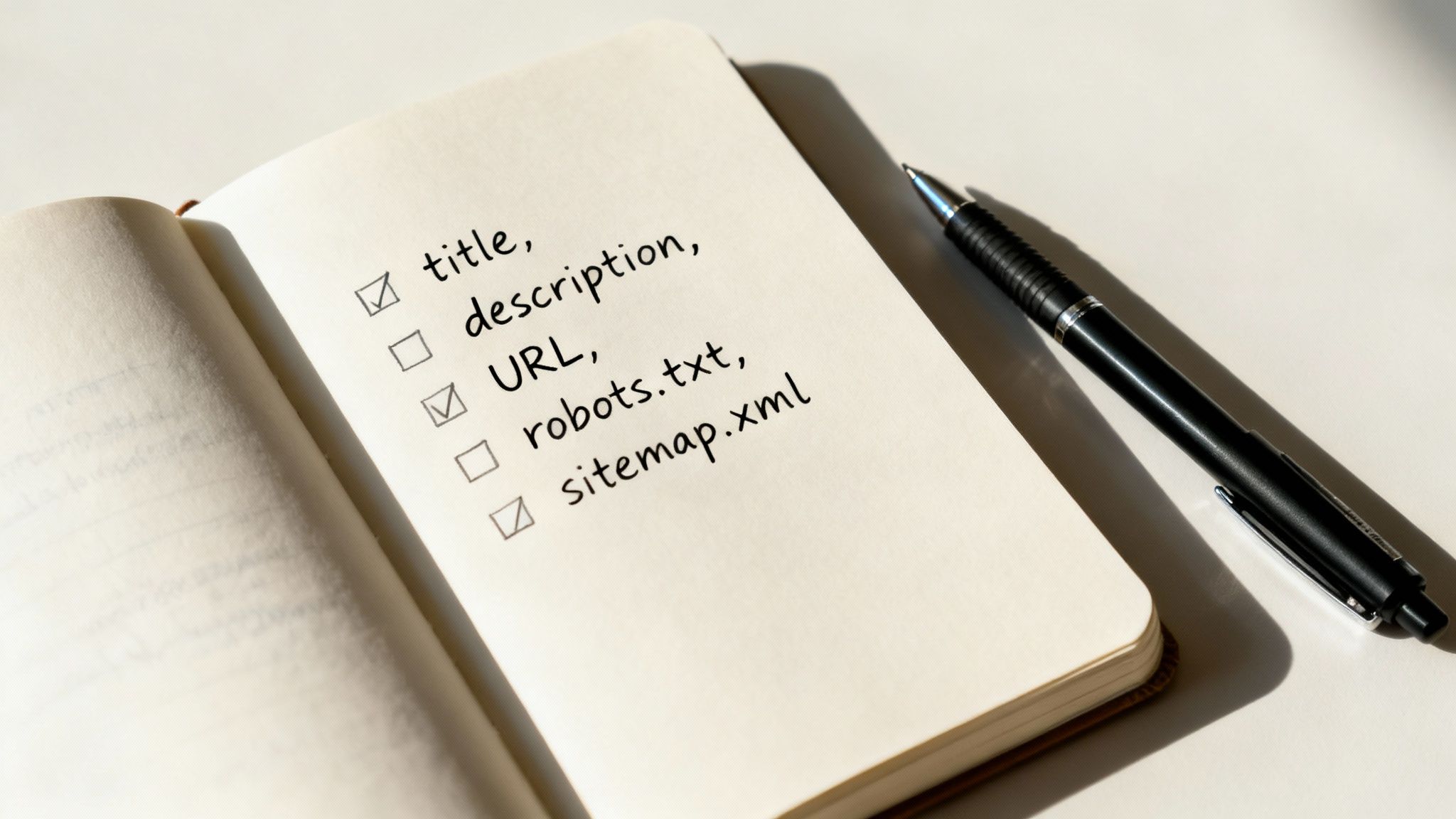
A SEO website audit is not just a technical check — it’s the true foundation of your search visibility. It’s a deep analysis of dozens of factors that directly determine whether customers will find you on Google.
Imagine cooking a complex recipe. Miss one ingredient or mix up proportions and the result falls flat. The same goes for a site: a single seemingly minor mistake can undermine months of promotion.
This section helps you run a basic error audit yourself. We’ll cover the key points so you can spot obvious issues, understand the current state, or simply verify your SEO contractor’s work.
Semantic and meta tag analysis
Any SEO analysis starts with semantics. Does your site “speak the same language” as your potential customers? In other words, does on-page content match the queries people actually search for?
Once that’s clear, move on to meta tags — Title and Description. These are the short snippets users see in search results before clicking your link.
- Title: Is it unique for every page? Does it include a key query? Is it the right length (ideally 55–65 characters)?
- Description: Is it compelling? Does it include a call to action? Does it avoid duplicating the title or random on-page text?
Proper meta tags are your business card in Google. They help crawlers understand your page and entice users to choose you over competitors.
Common meta issues — missing tags, duplicates, irrelevance — are among the most frequent mistakes. Fortunately, they’re easy to fix and can deliver a noticeable traffic boost.
Technical directives for crawlers
For Google to “read” your site correctly, it needs clear instructions on what to crawl and what to skip. Two files handle this: robots.txt and sitemap.xml.
robots.txtfile — the instruction set for crawlers. A single misconfiguration can accidentally block entire sections from indexing. Check that your money pages aren’t disallowed.sitemap.xml(sitemap) — a guide for Google. It shows your site’s structure and helps discover new pages faster. Ensure it exists, updates regularly, and doesn’t link to broken or blocked pages.
By the way, website information audits in Ukraine have their specifics. According to the State Committee for Television and Radio Broadcasting, over 67% of Ukrainians use Google Chrome, which directly influences optimization standards. Such an audit helps ensure your site meets modern requirements and is accessible to the vast majority of users. Read more in this data monitoring study.
Site structure and internal linking
A logical structure and thoughtful internal linking help both users and search engines navigate your site easily.
- URL structure: Page addresses should be short and human-readable. Instead of
site.com/cat1/p_id=567usesite.com/smartphones/iphone-15. - Internal links: Do pages link to other relevant materials on your site? This distributes “link equity” and speeds up indexing. Be sure to check for broken links that lead nowhere.
- Duplicate pages: Ensure you don’t have identical content at different URLs. Search engines may treat this as manipulation and apply penalties.
Even such a basic audit will help you spot critical issues and better understand which SEO goals are most important for you right now.
If you need an in-depth analysis and an objective evaluation of your team’s or contractor’s work, contact us for a professional independent SEO review. We’ll help you find not only errors but also hidden growth levers for your business.
How a professional website audit actually happens: step by step
A professional website audit isn’t just error scanning. Think of it as a meticulous car diagnostics before a major race. We don’t just look for faults — we figure out why they occurred and how to make your “machine” run faster than competitors. It’s a structured process where each step logically follows the previous one to form a complete picture.
It all starts not with code but with a conversation. Your site isn’t just a set of pages — it’s a key tool for achieving business goals.
Stage 1: Information gathering and goal setting
This is our “zero” stage — the foundation of the entire process. Here, we sync with you and your business to view the site through the same lens.
- Understanding business goals. What are you aiming for? More leads, higher direct cart sales, or increased brand awareness? Your answers determine our initial focus.
- Target audience analysis. Who visits your site? What are their pains? What information do they seek? This shows whether your resource speaks your customers’ language.
- Competitor research. We look “under the hood” of leaders in your niche. What tactics do they use? Where are their strengths and weaknesses you can turn into growth points?
Without this preparation, any technical check becomes a mere list of errors with no sense of what to do next.
Stage 2: Automated scanning + manual analysis
With strategy aligned, we move to the technical part, combining specialized tools with expert human review.
First, we run the site through professional tools like Ahrefs, Serpstat, or Screaming Frog. Think of it as an X-ray: scanners instantly reveal hundreds of systemic issues — broken links, duplicate pages, indexing errors, or slow pages.
But no bot replaces a human. Next comes the most interesting part — the manual error audit:
- Usability review: We walk your customer’s path — from first click to conversion. How convenient is it? Is everything clear?
- Logic and structure analysis: Is the menu logical? Is information easy to find?
- Content evaluation: Do your texts solve the user’s problem? Do they demonstrate expertise? Do they match search intent?
Stage 3: Data analysis and task prioritization
Here we become detectives, with evidence coming from Google Analytics and Google Search Console — your site’s onboard computer. We look for anomalies: sudden traffic drops, pages with unusually high bounce rates, and keywords where rankings fell.
The result of a quality audit is not a tome of problems, but a clear, prioritized action plan where every task has a defined criticality and an expected impact on outcomes.
Finally, we compile everything into a single document, rating each issue by criticality (how much it harms the site now) and fix complexity. This builds a roadmap where the top items deliver 80% of the results with 20% of the effort.
If you want more than a list of errors — namely, a strategic development plan — contact us for a professional independent SEO review. We’ll objectively assess your project and prepare clear technical tasks for your team.
Why you need an independent review of SEO work
Imagine you pay an SEO agency or freelancer every month, yet results are, frankly, invisible. Traffic is flat, rankings don’t grow, and the reports you receive paint an overly rosy picture that doesn’t match real sales. Familiar? That’s typical — and exactly where an independent SEO review comes in.
The best analogy is visiting a doctor. If the prescribed treatment doesn’t help, you seek a second specialist for an independent opinion. Likewise with your business: an independent website audit is that very “second opinion” for your site. It’s an objective outside view that reveals what’s truly happening with your project.
And no, it’s not about distrusting your contractors. It’s about common sense and controlling your investments so every dollar works to its full potential.
When to order an independent audit
Most often, people consider an independent check when the first “red flags” appear — signals that something is off and the current promotion strategy may be ineffective or even harmful.
Typical situations where professional expertise is essential:
- Money goes out, results don’t show. You regularly fund SEO, but organic traffic and rankings stubbornly won’t grow.
- Reports are a black box. You receive documents full of metrics, but no one can explain how they relate to business goals (leads, sales).
- Traffic suddenly tanked. The site lost Google rankings abruptly, and the contractor can’t clearly explain why or propose a plan.
- Doubts about competence. You see that the methods used are outdated and misaligned with modern search realities.
An independent audit isn’t just about finding technical errors. It’s a deep strategy review that uncovers missed growth opportunities, budget inefficiencies, and a simple mismatch between work quality and its price.
The entire process can be roughly divided into three stages: data collection, deep analysis, and final report preparation.
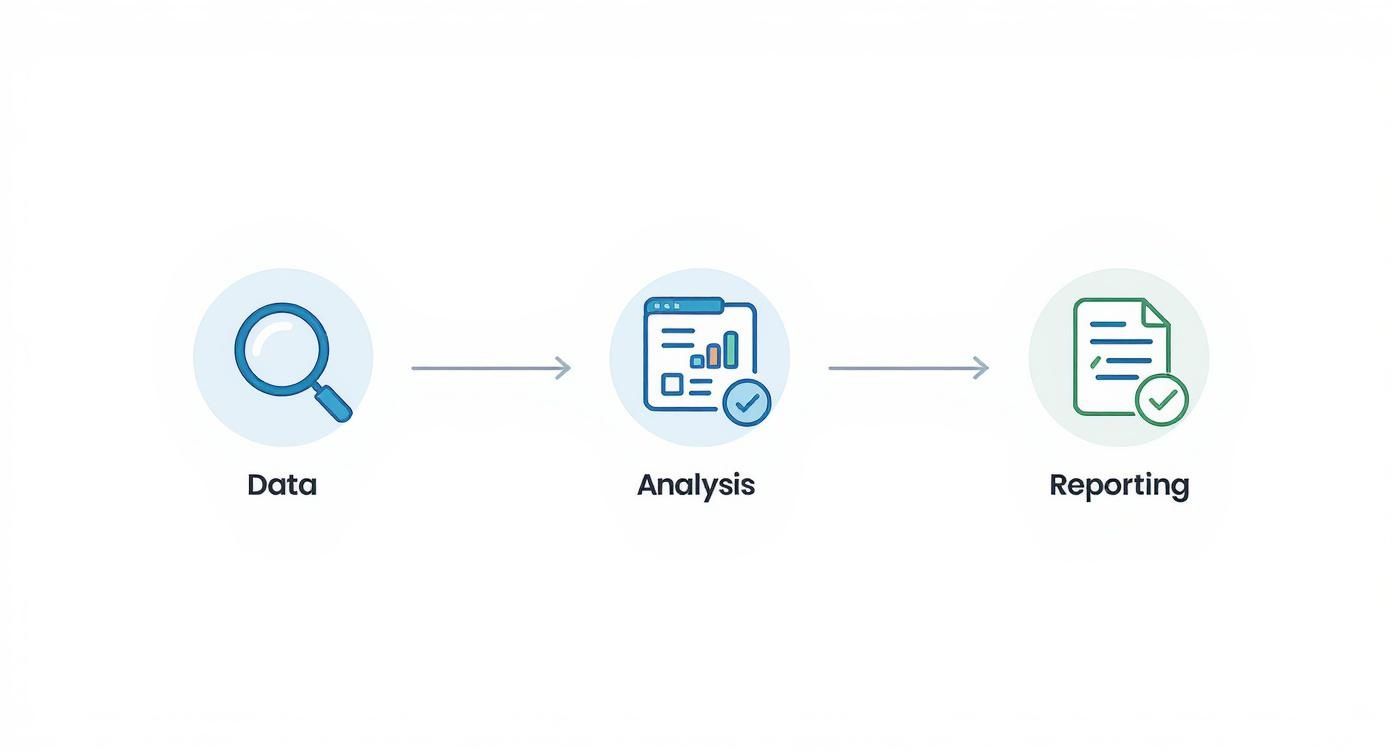
As you can see, it’s a logical, sequential process that guarantees a systematic approach to finding and solving problems.
What you’ll receive as a result
The outcome isn’t a dry error list but an objective assessment and, most importantly, a clear action plan — your roadmap to adjust the SEO strategy and improve its effectiveness.
The report details what was done well, where serious gaps exist, and exactly how to fix them. To better understand what such a document looks like and how it benefits a business, check our article on a professional SEO work review.
Want an unbiased assessment of your site and your contractors’ work? Contact us. We’ll perform a professional error audit and help you uncover growth opportunities you might not have considered.
Frequently asked questions about website audits
Let’s summarize the essentials. We’ve collected answers to the most common questions business owners ask when they hear about a website audit. Hopefully, this dispels any doubts and clarifies the practical value of the service.
How often should I audit my site?
It depends on your project’s size and how frequently things change.
For large players — e.g., online stores or news portals with daily content updates — we recommend a full SEO audit every 6–12 months. To stay on top of things, smaller technical checks can be run quarterly. This helps catch minor issues before they become major.
If you have a small corporate site or a simple company page with infrequent updates, an in-depth analysis every 1–2 years is usually sufficient.
One important note: an unscheduled error audit is a must after any major changes. Redesign, CMS migration, link structure changes, or — heaven forbid — a sudden traffic drop for no apparent reason? Time for an urgent check.
How does a DIY audit differ from a professional one?
In short — depth and quality of results.
When you audit yourself, you likely use free online scanners. They’re great for surface-level issues: a missing meta tag, a broken link, or an oversized image. A good starting point, but not a full picture.
A professional website audit is a different level. Specialists use advanced paid tools that analyze hundreds of parameters. More importantly, they bring experience: not just spotting errors, but understanding their origins and consequences.
The output isn’t just a list of problems — it’s a balanced strategy with concrete technical tasks.
What will I get by ordering a professional audit?
You’ll receive not just an error list but a true roadmap for growing your online business. A good professional report always includes:
- Detailed analysis. Clear explanations of what’s wrong and how each issue harms your site.
- Priorities. Tasks sorted by importance, so you know where to start for the fastest impact.
- Actionable instructions. Step-by-step recommendations on what and how to fix.
- Ready-made specs. Technical tasks for developers, copywriters, and other specialists, dramatically speeding up implementation.
If you feel your site underperforms or doubt your current contractors’ effectiveness, contact us. We offer a professional independent SEO review that provides an objective assessment and reveals real growth opportunities for your business.
Need a website that truly drives your business — or an objective assessment of your current project? At Moveiton, we don’t just build sites; we create effective customer acquisition tools. Request a consultation at https://moveiton.net.