
 Telegram
Turnkey website development — is when you entrust the creation of a website to a single team that guides the project from idea to launch and ongoing support. You set the task, and in the end you receive a fully ready business tool without diving into technical details or coordinating a dozen specialists.
Why businesses choose this approach
Imagine you are building a house. You can independently hire an architect, then look for bricklayers, separately — an interior designer, an electrician, a plumber. Everyone does their part, and you try to coordinate them all, resolve disputes, and hope the result matches the plan. It’s complex, time-consuming, and almost always leads to mistakes.
Turnkey website development is like working with a single general contractor. You hire one team that takes full responsibility for the final result.
Essentially, it’s not just a technical service, but a strategic partnership. Your goal is to get not a set of code and images, but an effective tool that attracts clients and generates profit.
This approach is becoming increasingly justified. The Ukrainian e-commerce market is growing rapidly — about 11 million Ukrainians already shop online regularly, and this number continues to grow. Under such conditions, a quality website is no longer just an option; it becomes a vital necessity for business. You can read more about current trends in the analytical review of the Ukrainian IT market.
Main advantages of turnkey development
When you order a comprehensive service, you get several tangible benefits that you don’t get if you build a site with a page builder or assemble a team of freelancers:
- One party accountable for everything. Any issues, from design to security, are handled by one team. This eliminates the classic situation of «the designer drew it, but the front-end developer can’t implement it».
- Saves your time and nerves. There’s no need to dig into technical nuances, search for contractors for each stage, and control their work. You can focus on your business.
- Professional and predictable result. An agency has established processes and experience that ensure high quality. Your site will be fast, responsive, and secure.
- Transparency and manageability. You get a clear plan, fixed deadlines, and a budget. This protects against sudden costs and project delays.
Simply put, turnkey development is an investment in the stable and reliable growth of your business online.
A step-by-step path to creating your website
Developing a «turnkey» website is not just a burst of creativity, but a clearly planned journey with specific stages. Each step logically follows from the previous one, ensuring that in the end you get a stable, functional product that 100% matches your business goals. Imagine assembling a Swiss watch: every gear must be in place, otherwise the mechanism won’t work.
This process can be easily visualized — from the first idea to the moment you receive a ready-made solution for your business.
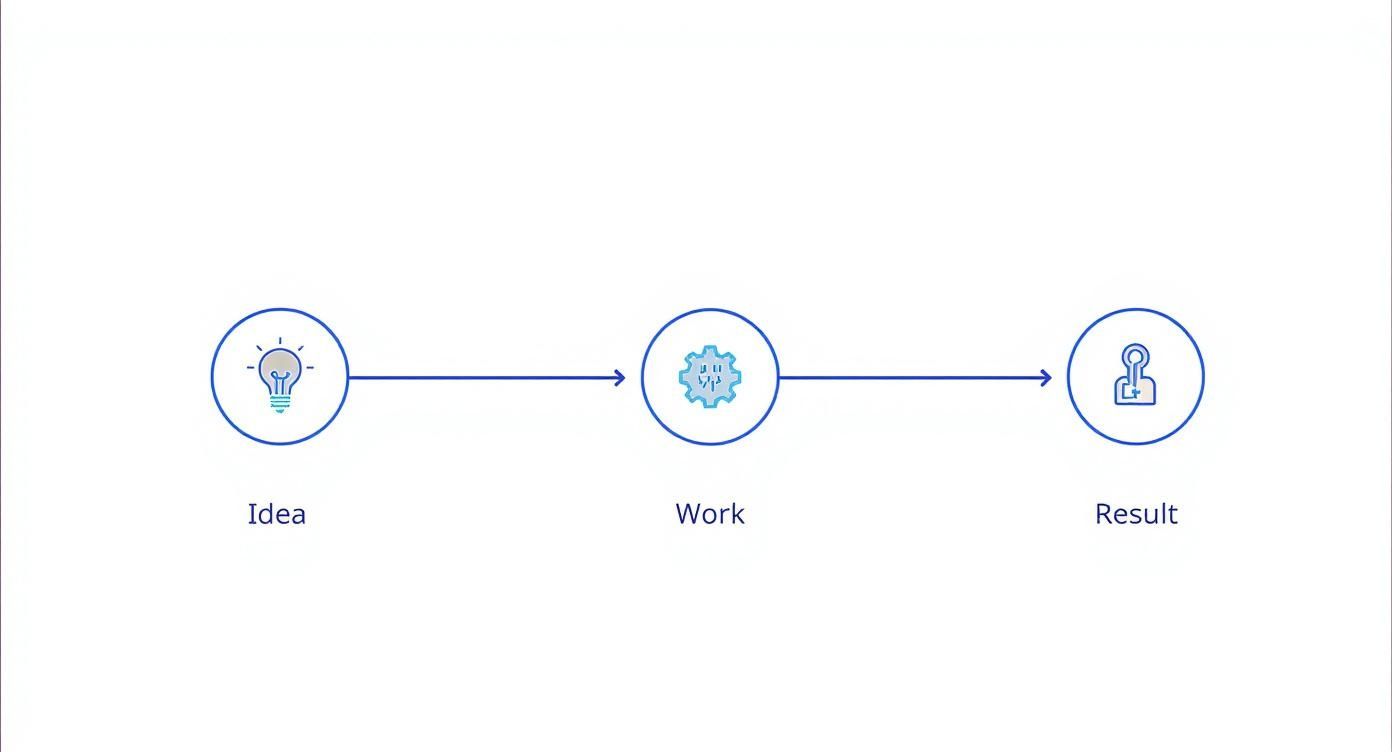
As you can see, everything starts with deep analysis, goes through the stages of design and development, and ends with handing over the symbolic key to your new digital asset. Let’s go through each step in more detail.
To better understand how the stages are connected, let’s look at a summary table. It gives a general idea of who is responsible for what at each stage and how long it may take.
Comparison of stages in turnkey website development
| Stage | Key tasks | Who is responsible | Estimated time |
|---|---|---|---|
| Analysis | Requirements gathering, market and TA research, creating the TS | Project manager | 1-3 weeks |
| UI/UX design | Creating a visual concept, developing page mockups | UI/UX designer | 2-4 weeks |
| Development | Markup (frontend), business logic programming (backend), integrations | Frontend and backend developers | 4-8 weeks |
| Testing | Functionality, responsiveness, security, and load testing | Developer, QA engineer (tester) | 1 week |
| Launch | Migration to hosting, domain connection, final setup | DevOps engineer, developers | 1-3 days |
This table is an approximate plan. Timelines may vary depending on project complexity, but the sequence of actions remains the same. Now let’s break down each item separately.
1. Analysis and prototyping
This is the foundation on which your entire project will stand. Skipping this step is like building a house without blueprints — the result will be unpredictable and, most likely, disappointing. At this stage, the development team literally immerses itself in your business to understand it from the inside.
Here are the key tasks of this stage:
- Understand business goals. What exactly do you want to achieve? Perhaps increase sales by 20%? Automate order intake? Or make a strong statement about your brand?
- Study the target audience. Who are your clients? What do they expect from the site? What is convenient for them and what is frustrating?
- Analyze competitors. What do they do well and where are their weak points? This helps find the very «hook» that will make you stand out in the market.
Once all the data is collected, a prototype is created — an interactive scheme of the future website. It’s not yet design, but rather a «skeleton» showing where buttons, forms, and other elements will be placed. The prototype lets you «click through» the site logic and assess usability before designers draw the first screen.
2. UI/UX design
When the structure is approved, UI/UX designers take over. Their mission is to breathe life into the black-and-white scheme, turning it into an attractive and intuitive interface.
UI (User Interface) is what we see: colors, fonts, icons, animations. UX (User Experience) is what we feel: how easy and pleasant it is to use the site to achieve our goal.
Good design is not just a pretty wrapper. It works for you: directs user attention, simplifies navigation, and most importantly, builds trust in your business. This is where the visual style that will be associated with your company is born.
3. Development and integrations
It’s time for the magic — design mockups turn into a fully functional website. This is the most complex technical stage, usually split into two parts:
- Frontend development. This is everything the user sees in their browser. Front-end engineers convert the design into live code (HTML, CSS, JavaScript), ensuring the site looks equally good on a small smartphone and a huge monitor.
- Backend development. This is the «brain» and «heart» of the site, hidden from the user. Developers write the code that drives the business logic, processes orders, manages databases, and connects the site to third-party services — payment systems, CRM, or delivery services.
It is at this stage that the site is «married» to a content management system. This can be a ready-made Content Management System (CMS), or building the site on a management framework, with the system’s functionality written uniquely for the project.
4. Testing and launch
Before your site goes live, it undergoes a real crash test. The QA team (QA engineers) checks absolutely everything: from every button’s behavior to page load speed and resilience against hacking attempts.
Here’s what is usually checked:
- Functionality: whether all forms submit and calculations are performed correctly.
- Cross-browser compatibility: whether the design remains intact across browsers (Chrome, Safari, Firefox).
- Responsiveness: how the site looks on phones, tablets, and laptops.
- Load: whether the site can handle surges in simultaneous visitors.
Only when all issues are caught and fixed is the site ready to launch. It is migrated to hosting (essentially, rented space on a server) and connected to your domain name. From that moment, your new business tool officially works for you 24/7.
What makes up the cost of development
«How much does a website cost?» — is the same kind of question as «How much does a car cost?» The answer is always: it depends on the configuration, functionality, and of course the brand. The price of turnkey website development is not taken out of thin air — it’s the sum of the hours of different specialists and the complexity of the technologies used.
When you understand what this amount consists of, you don’t just see the final figure. You see exactly what you’re paying for. This allows you to make balanced decisions: where you can save a bit without compromising quality and where you should invest for future growth.
Key factors that affect the price
The logic is simple: the more complex the project, the higher its cost. A basic one-page site (landing) requires far fewer resources than, say, a large online store with thousands of products, a customer account, and integration with your CRM system.
Here are the key points that directly affect the budget:
- Type of website. Landing, corporate portal, online store, or news site — each has its own unique set of features and, accordingly, its own price.
- Design uniqueness. Using a ready-made template is always faster and cheaper. But building an exclusive UI/UX from scratch that perfectly matches your brand and target audience is a completely different level.
- Functionality complexity. Any non-standard element — whether an online calculator, booking system, forum, or personal accounts — adds developer hours.
- Number of integrations. Connecting payment systems (LiqPay, WayForPay), delivery services («Нова Пошта»), CRM systems, analytics services — each such connection adds to the overall estimate.
For example, the website development price at Moveiton web studio can start from $2000 (for a one-page site), while a multi-page corporate website – from $4000. Meanwhile, SEO promotion of a project can cost from 30,000 UAH per month. Prices in the Ukrainian market are very flexible and depend on many factors.
Hidden and additional costs
When ordering turnkey website development, it’s important to remember that there are not only direct costs for the team’s work. There are also related but mandatory payments that should be factored into the budget in advance.
The cost of a website is not a one-time payment. It is an investment in its lifecycle: hosting, domain, technical support, and marketing.
These costs include:
- Domain name: Your unique address on the internet (for example,
vashcompany.com.ua), paid annually. - Hosting: Renting server space where your site’s files are physically stored. This service is paid monthly or annually.
- SSL certificate: It ensures a secure HTTPS connection, which is absolutely necessary for user trust and good search rankings.
- Technical support: System updates, regular backups, and security monitoring — all of this requires continuous expert attention.
How technologies influence the price
The choice of technologies your site will be built on is another cornerstone of the budget. Development on popular CMSs like WordPress is usually cheaper because there are many ready-made solutions and plugins for them.
However, when it comes to unique projects with high security and speed requirements, the best choice may be development on frameworks or custom management systems. For example, at Moveiton we often use our own CMF Atom. This allows us to significantly speed up website creation and provide a much higher level of protection.
To delve deeper into how different factors influence the final amount, we recommend our detailed article on how much website development costs.
Ultimately, the final price is always a balance between your ambitions, business goals, and available budget. The main thing is to clearly understand where your money goes and choose solutions that bring maximum long-term value.
How to find a reliable development partner
Choosing a contractor to build a website is arguably 50% of the project’s success. A good partner is not just «hands» to do the work. It’s a team that truly immerses itself in your business, understands its pains and goals, and offers solutions that work specifically for you. A mistake at this stage can cost not only money but also time and lost market opportunities.
Finding the ideal team is very similar to hiring a key employee. You need more than just technical skills. You need shared vision, honest communication, and confidence that they won’t let you down. Let’s break down how to approach this process so everything goes smoothly and productively.
Research the market and review portfolios
The first and most logical step is research. Start by looking for web studios on specialized rating platforms. Such sites provide an objective picture of the market because they are based on reviews from real clients.
For example, here’s a screenshot from Clutch — one of the most well-known global resources where you can find rankings of web developers in Ukraine.
Here you can quickly filter leaders, view their specialization, and see the average project budget. This will immediately help narrow your search to those who match your scale.
But simply scrolling through pretty pictures in a portfolio is a trap. Each project needs a deeper look.
Real experience is not the number of sites in a portfolio but the results achieved for clients. Look for not just great design but solutions to specific business problems.
What to look for when reviewing an agency’s work:
- Diversity of projects. Has the team worked in your or a similar niche? Experience in your field is a huge plus because they already understand its specifics.
- Technical complexity. Is there anything more advanced than simple landing pages? Online stores with integrations, custom web services — all of this reflects the team’s level.
- Case studies and results. The best studios don’t just show screenshots. They tell the story: the problem, the solution, and the numbers achieved. For example, «increased traffic by 40%» or «raised conversion by 15%».
Checklist of questions for the first meeting
Once you’ve selected 2-3 favorites, it’s time to meet. The first meeting or call is your chance to «feel out» the team, assess their competence, and understand whether you will be comfortable working together.
To make the conversation substantive, prepare a list of questions. Here are a few key topics that are definitely worth discussing:
-
Workflow
- What stages does your project work consist of?
- Who will be my account manager and how will we communicate?
- How often will I receive progress reports?
-
Technical aspects
- Which technologies do you propose for my project and, most importantly, why?
- Will I be able to edit content myself via a convenient admin panel (CMS)?
- Do you provide training on how to use the site after launch?
-
Contract and guarantees
- What exactly is included in the quoted price? Are there any hidden fees?
- Is there a warranty support period after launch? What does it include?
- What are the payment terms? Are they tied to specific milestones?
These questions help assess not only technical expertise but also the approach to customer service and process transparency.
What else to pay attention to
Beyond portfolios and direct answers, there are also nonverbal signals that can say a lot about a potential partner.
Red flags to beware of:
- Price that is too low. If an offer is significantly below the market average, it almost always means a compromise: low quality, templated solutions, or hidden charges later.
- No questions for you. If the contractor doesn’t ask about your business, goals, and audience, the result doesn’t matter to them. They just want to fulfill the spec.
- Promises of «fast and cheap». Quality turnkey website development is a marathon, not a sprint. Unrealistic deadlines almost guarantee missed timelines and quality issues.
- Vague contract. All agreements, stages, deadlines, and costs must be clearly documented. Avoid cooperation «on a handshake».
A reliable partner always plays the long game. They aim to be your advisor who helps turn an idea into a successful digital product, not just to get quick money.
What to do after your site is launched
Launching a site is like launching a ship. It looks great, but ahead lie long voyages, storms, and new horizons. It’s not the finish line, but the start of a long and exciting journey to success.

Once you receive the keys to your new digital home, you become its captain. The main task now is not just to keep it afloat, but to confidently steer it toward your business goals. For this, you need two things: stable technical support and a smart growth strategy.
Technical support as the basis of stability
Imagine you bought a new car. You wouldn’t just drive it until it breaks down, would you? No, you regularly service it, change the oil, and check the brakes. It’s exactly the same with a website.
Continuous technical support guarantees uninterrupted and secure operation. It usually includes:
- Regular updates. Content Management Systems (CMS) and plugins are constantly updated to close vulnerabilities and add new capabilities.
- Backups. Your insurance against force majeure — from server failures to hacking attacks.
- Security monitoring. Specialists track suspicious activity to prevent break-ins and protect your data and your clients’ data.
Launching without ongoing support is like sending a ship to sea without lifeboats. You risk losing everything due to a single unforeseen problem.
Growth strategy: how to attract visitors
A site that no one visits is just a beautiful display window in a dark alley. To generate profit, it needs targeted traffic. And this is where the most interesting part begins — marketing and promotion.
According to the Digital 2025 report, the number of internet users in Ukraine has reached 31.5 million people. Most of them search for information on Google from mobile devices. This means your site must be not only accessible but also visible to them. To better understand your audience, it’s worth reading about trends in the Ukrainian internet environment.
Key tools for driving traffic:
- SEO. Working to ensure your site appears at the top of Google for queries important to your business. It’s a long-term investment that brings a steady flow of organic traffic.
- Content marketing. Helpful blog articles, compelling case studies, video reviews — fuel for your site. Quality content attracts audiences, builds trust, and demonstrates your expertise.
- PPC (Google Ads). The fastest way to get initial clients. You pay to have your ads shown to interested users in Google search and on partner sites.
To understand where to start with SEO, it’s worth running an in-depth analysis of your site. In our blog, we explained in detail what a website SEO audit is and why you need it to help you take the first steps.
And of course, don’t forget analytics. Tools like Google Analytics let you see where visitors come from, what they do on the site, and at which stage they leave. Analyzing this data is the key to continuous improvement of your online business.
Frequently asked questions about turnkey website development
When it comes to such a serious investment as turnkey website development, it’s perfectly logical to have many questions. To dispel any doubts and help you make the right decision, we’ve gathered here the answers we hear most often.
Of course, every project has its unique nuances, but there are certain points that concern almost every client. Let’s go through them in order.
How long does website development take?
Timelines depend directly on how complex and large your future site will be. It’s impossible to name a universal number, but we can outline approximate ranges to help you plan.
Here’s how it usually looks for different project types:
- Simple landing page (Landing Page): Typically takes from 2 to 4 weeks to build. A great solution if you need to quickly launch a campaign or test a new idea.
- Corporate website: Development can take from 1 to 2 months. The structure, design, and content require much deeper work here.
- Online store: Building a full-fledged e-commerce platform is significantly more complex. The process can take from 3 to 6 months, and sometimes longer, especially if non-standard integrations or unique functionality are needed.
One more important point: the speed of your communication at each stage also greatly affects the overall development time.
The clearer you outline your wishes in the technical specification and the faster you provide feedback, the more promptly our team will reach the finish line.
Will I be able to make changes myself after launch?
Absolutely! This is one of the key principles of a «turnkey» approach. After launch, you won’t need to contact us for every minor update. We build sites on convenient and intuitive Content Management Systems (CMS).
Once the project is ready, we will definitely conduct a short training for you or your staff. You’ll easily learn to add products, write blog posts, change on-page texts, or update gallery photos yourself. This gives you full freedom of action and control over your resource.
What is usually included in technical support?
Technical support is essentially your insurance policy that ensures the site runs stably and remains secure. A standard package typically covers the most important things:
- Regular updates of the CMS and all its components to close potential vulnerabilities.
- Creating backups of the site — in case something goes wrong.
- Monitoring the site’s availability 24/7 so it’s always accessible to visitors.
- Consultations if you have any questions about the site’s operation.
If you need to add new functionality or an entire section, such work is usually estimated and paid for separately.
Is basic SEO included in development?
Yes, definitely. Quality turnkey development is unthinkable without basic technical SEO. It’s the foundation for your further search engine promotion. This includes setting a clear URL structure, optimizing load speed, proper mobile rendering, and other important technical aspects.
Ready to turn your idea into a powerful business tool? At Moveiton, we don’t just build websites — we create solutions that work and deliver results. Order a free consultation, and we’ll help you take the first confident step toward online success. Learn more at https://moveiton.net.