
 Telegram
Turnkey website development — is when you entrust the creation of a website to a single team that does absolutely everything from start to finish. As a result, you get not just files and images, but a ready business tool that starts delivering value from day one.
What turnkey website development really means
The best analogy is building a house. You wouldn’t separately hire an architect, then look for a crew for the foundation, then chase electricians, plumbers, and designers, trying to make them all work together, would you? Instead, you turn to a single construction company. It handles everything: from drawings and permits to the final cleaning.
Turnkey website development follows the same principle. It’s not just «draw a design» or «write code». It’s a unified process where one team takes full responsibility for the final product and its quality.
How this differs from working with freelancers
The main difference lies in management and responsibility. When you hire separate specialists, you automatically become the project manager. You’ll have to coordinate the work of the designer, front-end developer, and programmer, resolve conflicts (and they will happen, for example when a designer creates something technically difficult or expensive to implement), and keep an eye on each person’s deadlines.
The «turnkey» service takes this headache off your shoulders. You communicate with a single manager who keeps their finger on the pulse of the entire process.
In this case, the agency becomes your partner, not just a contractor. Its goal is not simply to «make a website», but to help you achieve business goals: get more orders, attract new clients, or strengthen your brand image.
Many underestimate the complexity of coordination. Let’s look at it in a table to make the difference clear.
Comparison of approaches to website creation
Assessment of scope and responsibility when ordering a «turnkey» service versus working with individual freelancers.
| Work stage | «Turnkey» service (single contractor) | Working with freelancers (requires coordination) |
|---|---|---|
| Strategy and analysis | The agency conducts research; you’re responsible only for providing business information. | You need to find a marketer yourself or draft a specification based on your own vision. |
| Design (UX/UI) | The designer works in a team with developers, creating a realistic and functional mockup. | You need to find a designer, explain the task, and then ensure their mockup is feasible. |
| Development (Frontend/Backend) | Developers receive a vetted specification from the manager and work to a single plan. | You must hand the design to the front-end developer, then to the programmer, resolving compatibility issues. |
| Content | A content manager fills the site according to the approved structure. | You or a separate specialist manually add texts and images, figuring out the admin panel. |
| Testing and launch | A testing team checks everything comprehensively and fixes issues before release. | Each contractor tests only their part. The overall check falls to you. |
| Responsibility | Single point of responsibility — the agency. If something doesn’t work, you know whom to contact. | Blurred responsibility. The designer may blame the developer, and the developer — the designer. |
As you can see, working with freelancers may seem cheaper at the start, but it requires far more of your time, nerves, and management competence.
What’s usually included in a «turnkey» package
Of course, the service composition may differ slightly among studios, but there’s a baseline that’s non-negotiable. It’s not just a set of technical tasks, but steps that ensure your site is a viable project.
Here’s what you will definitely get:
- Analytics and strategy. The team first studies your niche, looks at what competitors are doing, and defines your target audience. This is needed to build the right site structure.
- UX/UI design. Specialists plan the site logic for user convenience (UX), and then create an appealing visual style (UI).
- Technical development. This includes markup (turning design into code), programming all the functionality, and mandatory adaptation for smartphones and tablets.
- Content population. Your texts, photos, videos, and other materials are carefully placed on site pages.
- Basic SEO optimization. The site is configured so that search engines like Google properly «understand» and index it. This is the foundation for future promotion.
- Testing and launch. Before «going public», the site is thoroughly checked for errors, all issues are fixed, and it’s migrated to your hosting.
This comprehensive approach ensures you get not just a pretty picture, but a full-fledged business asset ready to attract clients. It’s an investment in a predictable outcome that saves your time and nerves.
Key stages of creating your website
Turnkey website creation is not some magical process happening behind closed doors. It’s a clear and consistent workflow, akin to building a house: first the foundation, then the walls, and only after that the interior finishing. Each step logically follows from the previous one.
The most important thing is collaboration. Especially at the start, when your ideas and business goals become the very foundation for the entire project. Let’s go through the whole journey so you know exactly what happens when.
Stage 1: Briefing and analytics
Everything starts with a conversation. At this stage, we don’t just listen; we truly immerse ourselves in your business. We need to understand your goals, who your client is, what your competitors are doing, and what «successful website» means for you. The result of this deep analysis is a technical specification (TS) — a detailed project roadmap that records everything from structure to the smallest functions.
Believe us, this is the most important stage. A well-written TS is like a solid foundation. If something is missed here, you’ll spend much more time and money on rework later.
Stage 2: Planning and prototyping
With a clear TS in place, our UX designer creates the site’s «skeleton» — an interactive prototype. Imagine a black-and-white blueprint showing where all buttons, blocks, and menus will be, and how a user will move between pages.
The prototype is a great opportunity to «click through» the future site before a single pixel is drawn. This way we can easily find usability issues in navigation and fix them quickly and painlessly.
Stage 3: UI/UX design development
Prototype approved? Great! Now the UI designer turns our functional «skeleton» into a stylish and attractive product. They work to make everything look harmonious:
- Color palette. Selects colors that fit your brand and evoke the right emotions in visitors.
- Typography. Chooses fonts that are comfortable to read on any screen.
- Icons and graphics. Creates unique visual elements that complement the overall style.
- Responsiveness. Plans from the outset how the site will look on smartphones, tablets, and large monitors. This is critical, as over 94% of mobile connections in Ukraine are broadband, meaning most of your clients will view the site from a phone.
At the end, you receive ready design mockups of all key pages.
This infographic shows how all stages are connected — from the first idea to production-ready code.
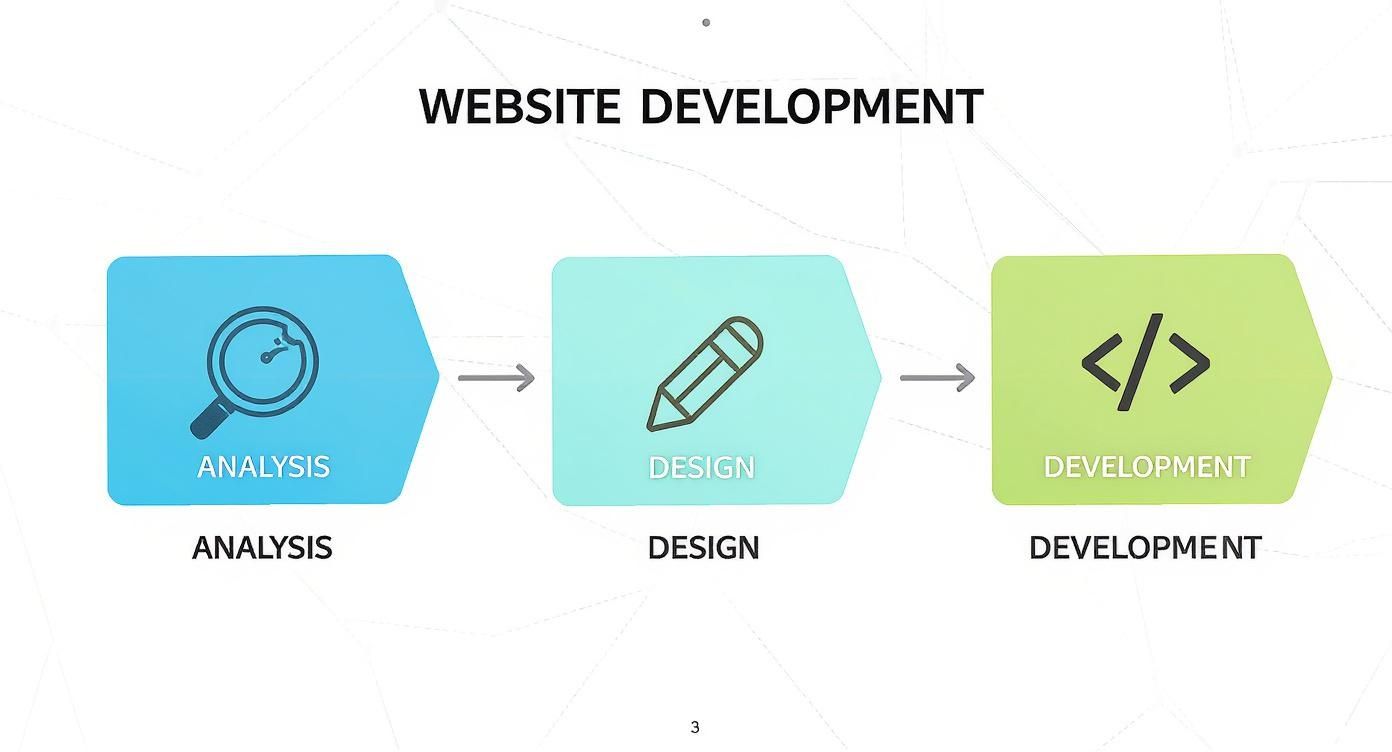
As you can see, each stage logically builds on the previous one, ensuring the entire process runs smoothly.
Stage 4: Markup and programming
Time for technical magic. First, a front-end developer turns static design images into live HTML pages that look equally good in all browsers. Then the backend developer gets to work and truly «brings the site to life»:
- Configures the Content Management System (CMS). At Moveiton, we often use our in-house CMF Atom based on Codeigniter 4. It makes the client’s admin panel as simple and fast as possible.
- Programs all functionality. This can be anything from a simple contact form to a complex personal account, a shopping cart for an online store, or integration with your CRM.
- Connects third-party services. For example, payment systems, delivery services, or analytics tools.
Stage 5: Content population and testing
When the technical foundation is ready, we bring the site to life — adding texts, photos, videos, and products. Right after that, the most responsible stage begins: exhaustive testing. Our QA team checks absolutely everything:
- Whether all buttons, forms, and links work correctly.
- How the site displays on different devices and in different browsers (Chrome, Safari, Firefox).
- Whether there are code errors and how fast pages load.
All discovered «bugs» are logged and sent back to developers to fix. This cycle repeats until the site runs like a Swiss watch.
Stage 6: Launch and ongoing support
The final chord! We migrate the finished site from the test server to your live hosting and domain. But our cooperation doesn’t end there. We will definitely train you or your staff to use the admin panel and will stay in touch for further technical support.
Remember, open communication and your involvement at each stage are the best guarantees that turnkey website development will deliver results that 100% meet your expectations.
Choosing the right type of website for your business
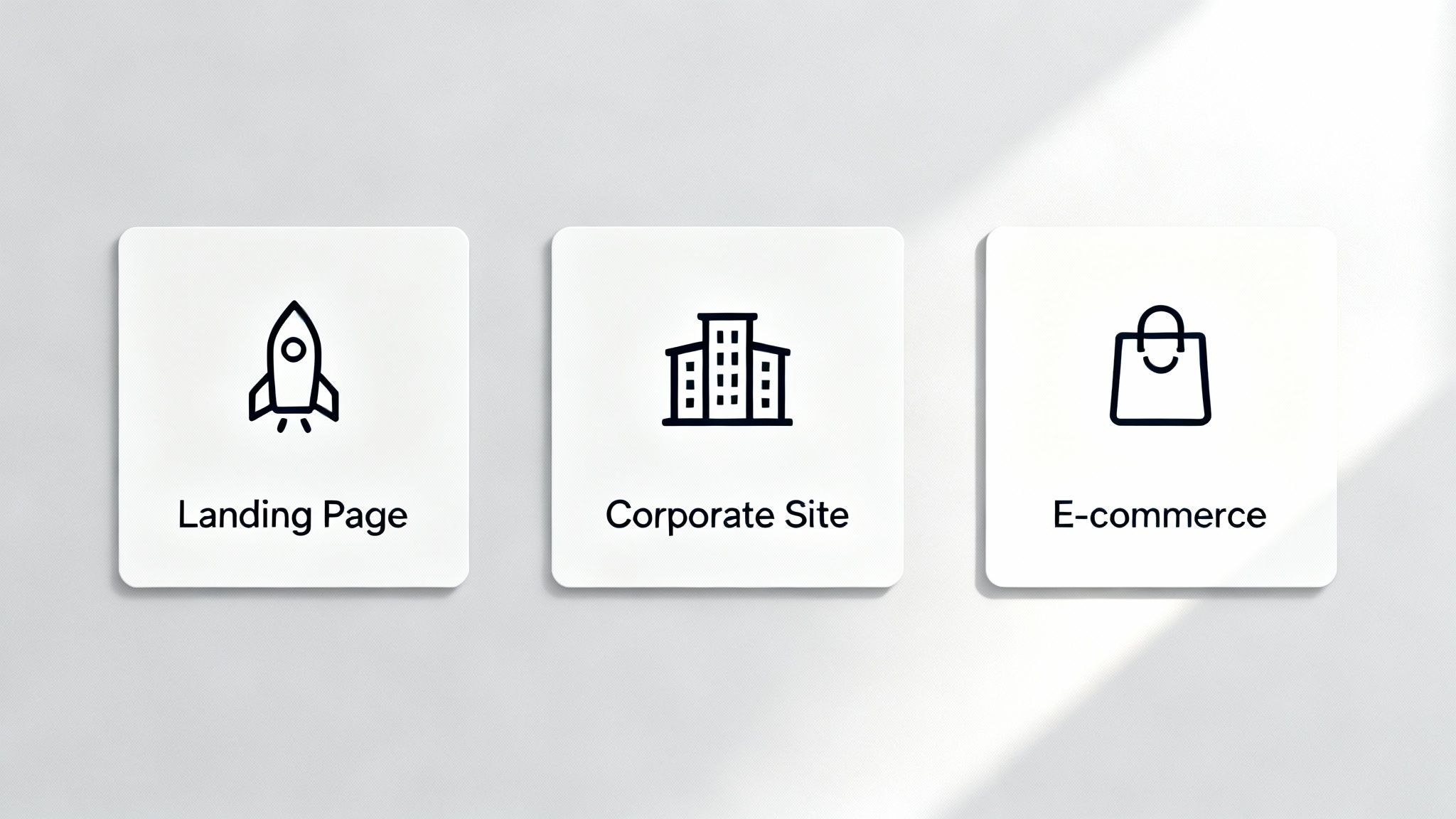
When you order turnkey website development, the first and most important question is: what kind of site do you need? There’s no universal answer. The same resource cannot equally effectively sell a specific service, build the image of a large corporation, and process thousands of online orders. Each type of site is a tool designed for specific business goals.
It’s like choosing transport: for a quick city ride, you take a scooter; for a family trip — a minivan; and for moving cargo — a truck. The same applies to websites. The right choice at the start guarantees you won’t waste money and will immediately invest in functionality that brings real value.
Landing page
A landing page is your digital sniper. Its task is singular: persuade the visitor to perform a specific action. Submit a request, call, subscribe to a newsletter, or buy a product. It’s always a one-page site where all information leads the user to the final step.
What a landing page is perfect for:
- Selling a single product or service. A great option for launching a new product or a special offer.
- Lead generation. Essential when you need to attract people to a webinar, consultation, or send them a commercial offer.
- Testing demand. Lets you check whether a business idea will «take off» with minimal investment before creating a full-fledged shop.
Thanks to this focus, landing pages often show significantly higher conversion rates than multi-page sites. To understand their structure and operating principles, see our detailed article on what a landing page is and how it works.
Corporate website
If a landing page is a sniper, a corporate website is the face and headquarters of your company on the internet. Its tasks are much broader than just selling. It must inspire trust, explain your activities in detail, demonstrate expertise, and work for the brand’s long-term image.
A corporate website is not just an online business card. It’s a powerful tool for communication with clients, partners, and future employees. It tells your story, conveys your values, and shows why people should work with you.
Such a resource usually has a complex structure: detailed descriptions of services, a portfolio with case studies, an «About» section, a blog, a careers page, and contacts. It’s a solid foundation for SEO and content marketing.
Online store
An online store is a full-fledged commerce platform built for online sales. It’s the most complex and, accordingly, the most expensive type of site to develop, as it requires many specific functions that ensure the entire purchase cycle from A to Z.
What an online store must have:
- Product catalog. Convenient navigation, filtering, sorting, and informative product cards.
- Cart and ordering system. An intuitive process that won’t make the customer abandon midway.
- Payment system integration. The ability to pay for an order securely right on the site.
- Personal account. Order history, saved addresses, wishlists — everything to convenience loyal customers.
- Integration with delivery services and CRM. Automation that saves time and reduces errors.
The modern market requires businesses to be online. As of January 2025, Ukraine’s internet audience numbered 31.5 million users, with an internet penetration rate of 82.4%. This is enormous potential for business, especially considering that 94.1% of mobile connections are broadband. Website responsiveness is no longer an advantage but a necessity.
Choosing the right type of site is a strategic decision that determines your future online success. Analyze your goals, resources, and audience, and your choice will certainly be the right one.
What the website price is really made of
Asking «How much does a website cost?» is almost the same as asking «How much does a car cost?» There’s simply no universal answer. The price depends on the «configuration»: design, the «engine’s» power, and a host of additional options. The same applies to turnkey website development — the final budget comprises the hours of different specialists and the complexity of the technologies they use.
When you understand exactly what you’re paying for, studio proposals become transparent. You’ll be able to see where there’s room for smart savings and where trying to save today may lead to serious problems and costs tomorrow.
Design: template or exclusive?
The first major budget driver is design. There are two fundamentally different paths here, each with its own price.
- Template design. Like buying an off-the-rack suit. Fast, inexpensive, but not unique. Your site won’t be one-of-a-kind, and the ability to change things is minimal. A great option if you need to launch «yesterday» and the budget is very limited.
- Custom design. This is a tailor-made suit. First analytics, then prototypes (UX), and only then the visual part (UI). It’s longer and more expensive, but worth it: the site looks professional, fits your brand perfectly, and is memorable to clients.
If you want complex animations, 3D graphics, or any non-standard visual features, be prepared for this to add to the design cost as well.
Functionality: what’s «under the hood»?
Functionality is everything a site can do besides displaying text and images. The rule is simple: the more «capabilities» you need, the higher the price.
For example, a basic contact form is a staple. But a service price calculator, a customer account with order history, or integration with your CRM are tasks that require many developer hours.
It’s important to remember that the invisible part of a site (the backend) is often the most complex and therefore the most expensive. It’s like a car engine: you don’t see it, but it’s what makes everything work.
The Ukrainian web development market in 2025 offers solutions for any budget. You can start with a website builder for 207.25₴ per month. Projects with complex functionality, such as online booking systems, will cost from 1,245.97₴ monthly. You can find more pricing details in the Website Planet study.
Scope of work and related services
The number of pages to be planned, designed, and developed also directly affects the price. A one-page landing will be much cheaper than a 20-page corporate site or an online store with thousands of products.
Beyond development itself, other important items are often included in the budget:
- Content population: copywriting, photo or video preparation.
- Basic SEO optimization: configuring the site to be favored by search engines.
- Buying a domain and hosting: the address and «home» for your site.
- Technical support: post-launch help to keep everything running like clockwork.
Understanding these components gives you flexibility. For instance, you can start with a simpler version of the site and add more complex features later as your business grows. To better understand how different factors shape the final amount, check our article on how much website development costs in 2026.
How to find a reliable development partner

Choosing a contractor for turnkey website development is, without exaggeration, a key decision that determines 50% of the project’s success. It’s not just about finding a vendor. It’s choosing a long-term partner who will deeply immerse in your business and turn your ideas into an effective digital tool.
The market is crowded with offers, and it can be hard to navigate. How do you avoid mistakes? Finding the ideal team is like choosing a good doctor: you’re not looking for the cheapest, but for the most competent — someone you can trust. Let’s break down what to focus on.
Study portfolios and case studies in depth
The first step is to dive into the agency’s portfolio. But it’s important to look beyond pretty pictures. Your task is to understand the depth and quality of the team’s completed work.
What to look for:
- Diversity of projects. Does the studio have experience in your niche or adjacent ones? If the agency has worked successfully with different types of businesses, it indicates flexibility and adaptability.
- «Live» sites. Don’t be lazy — follow the links and explore real projects. Assess page load speed, navigation convenience, and the overall user experience.
- Case content. A strong agency doesn’t just show screenshots. It tells the story: the client’s problem, the goals, and the specific results achieved.
Look for specific figures in case studies, not just «we built a site»: «increased conversion by 15%» or «reduced bounce rate by 20%». That is the best proof the team is focused on business outcomes.
Check reviews and reputation
Reviews are social proof of competence. But you should analyze them properly. Don’t limit yourself to enthusiastic comments on the studio’s own site — those will always be positive.
Instead, look for mentions on independent platforms, in IT company directories, or professional communities. Especially valuable are detailed reviews where clients describe not only the pros but also possible nuances of cooperation. This helps form an objective picture.
Hold an «interview» and ask the right questions
Once you’ve identified 2–3 favorites, it’s time for direct communication. The first consultation isn’t just about price. It’s your chance to assess how genuinely interested the team is in your project and how ready they are to dive in.
Key questions to ask:
- How will you study my business and target audience? A reliable partner always starts with analytics, not with button colors.
- What tech stack do you use and why? The answer shows the team’s technical maturity. For example, at Moveiton we often use our CMF Atom based on Codeigniter because it’s fast and enables very simple admin panels for clients.
- How will communication and reporting be organized? You must clearly understand how often you’ll receive updates and whom to contact with questions.
- Who will own the site and all access credentials after completion? This is critical and must be documented.
Research on the Ukrainian web development market for 2023 revealed an interesting trend: 28% of companies complete 15 to 30 projects per year, and 25% — fewer than 10. This indicates that many studios prioritize quality over volume, allowing deeper work on each project. Learn more in the IT Rating study.
Insist on a transparent contract
The last but equally important stage is formalizing the relationship. The contract is your main protection and the project roadmap. It must be as detailed and clear as possible.
What must be included in the contract:
- A clearly defined technical specification (TS).
- Final deadlines for each stage.
- Payment procedure and milestones.
- Warranty obligations and terms of ongoing support.
By choosing a partner for turnkey website development, you invest not just in code and design. You invest in experience, expertise, and reliability. This approach helps you obtain not just a beautiful site but a powerful tool for your business.
Most common questions about «turnkey» websites
Finally, let’s go through the questions we at Moveiton hear most often. This section will help you put everything in order and fully understand how the website creation process works from A to Z.
How long will it take?
Timelines are always about balancing complexity and scope. As with construction: a single-story cottage and a skyscraper require entirely different time and effort. Web development is analogous.
To help you plan, here are approximate timelines for different site types:
- Landing page (Landing Page). We usually complete it in 2–4 weeks. It’s the fastest option since all work is concentrated on a single page with a clear goal.
- Corporate website. This process typically takes from 4 to 8 weeks. Time depends on the number of pages, design complexity, and extras like a blog or portfolio.
- Online store. This is our «skyscraper». Development takes from 8 weeks to several months. Most time goes into the catalog, connecting payment systems, and CRM integration.
Keep in mind: these timelines are realistic when we work hand in hand. Your prompt responses, timely materials, and stage approvals are the best catalyst for the project.
Who will own the site after launch?
A very proper and important question. The answer must be unambiguous: you become the owner of the site. Period.
When all work is completed and paid for, a professional studio hands over the keys to your new «digital home»:
- Access to the hosting where all files reside.
- Access to the domain management panel.
- Login and password to the site’s admin panel.
Make sure this point is clearly stated in your contract. If the contractor tries to keep access, that’s a serious red flag.
What is technical support and what’s included?
Launching a site is only half the job. Then comes its life on the internet, and it needs care just like a car needs regular service. That’s what technical support is for.
Here’s what is usually included in a basic package:
- Uptime monitoring. We ensure your site runs 24/7 and is always online for clients.
- Backups. We regularly create site backups so everything can be restored instantly in case of force majeure.
- CMS and plugin updates. This is a security matter. Outdated code is an open door for hackers, and we keep it firmly shut.
- Consultations. We help resolve minor issues that arise while working with the site.
If you need more, such as adding new features or regularly publishing articles, that’s extended support that can be ordered separately.
We hope this guide has given you a complete picture of what «turnkey» website development is. If you’re looking for a reliable partner to create a powerful digital tool for your business, the Moveiton team is at your service. We’re ready to discuss your project and offer a solution that delivers real results. Request a consultation at moveiton.net.