
 Telegram
What is a turnkey website? Imagine you decide to build a house. You can look for an architect yourself, then a crew for the foundation, others — for the walls, and someone else — for the roof and interior. Or you can contact a company that will handle everything: from the project to the final cleaning. You simply receive the keys and move into a finished home.
Turnkey website development works on the same principle. It is a comprehensive service where one team accompanies your project from the initial idea to launch and ongoing support. It is an ideal solution for business that allows you to focus on your work while entrusting all the technical tasks to professionals.
What the «turnkey» service really means
In practice, «turnkey» is much more than just «built and handed over». It is a partnership format where a web studio becomes your temporary IT department. You are not simply buying a bundle of code and images; you are investing in a ready-made business solution that already includes strategy, expertise, and technologies.
The headache of finding and coordinating a dozen specialists disappears. You don’t need to separately hire a designer, then look for a front-end developer to implement their ideas, then — a programmer, and finally — an SEO specialist to promote it all. The entire team is already assembled, works smoothly, and moves toward a common goal.
Key advantages of a comprehensive approach
The greatest value of the turnkey website development service lies not only in convenience but also in business benefits. When you choose this format, you get:
- A single point of responsibility. Did something go wrong? Have questions? You know exactly whom to call. No more «that wasn’t us, the designer drew it that way» or «the developers did it wrong».
- Saves your time and nerves. Searching for and interviewing individual freelancers can take weeks. A ready team starts working immediately, significantly speeding up the entire process.
- Technological integrity. When one team works on the project, the design, code, and functionality are perfectly compatible. It’s like an engine assembled at one factory — all parts fit perfectly, eliminating «conflicts» and failures.
- Strategic view of the project. A professional studio sees a website not as an end in itself but as a tool for your business. Everything starts with an analysis of the market, competitors, and your audience, and the entire subsequent work is built on this data.
Ordering a turnkey website is not just a way to «delegate and forget». It’s about finding a reliable technical partner who will dive into your business goals and help achieve them with the right digital tools.
Instead of juggling dozens of tasks, you communicate with a single project manager. They keep you updated, explain complex things in simple terms, and advise you at every stage. This allows you, as a business owner, to focus on the essentials — strategy, sales, and growth — while experts build a powerful online platform for your expansion.
How turnkey website development works
Creating a «turnkey» website is not magic but a well-planned process similar to building a house. There is a foundation, walls, a roof, and interior finishing. Each step is performed sequentially, and you, as the client, always know what stage we are at and what comes next.
Let’s walk this path so you can see the entire «behind-the-scenes» process.
Stage 1: Briefing and analytics
Everything starts with a conversation. But it’s not just small talk — it’s a deep dive into your business. We ask many questions: who your clients are, what pains they have, how you are better than competitors, and what tasks the website should solve. This is the foundation without which it is impossible to move forward.
We analyze the market, look at what your competitors are doing — what they do well and where they make mistakes. We study your target audience. The result of this stage is a shared vision of the future project.
It’s important to understand: a detailed brief is not a formality. It is the key to success. The better we understand your business at the start, the more precisely the final result will hit the target.
Based on all the information, we prepare a commercial proposal and move on to the next step.
Stage 2: Technical specification and prototyping
Technical specification (TS) is essentially an instruction for the entire team. In this document, we describe in detail the structure of the website, how each button and each form will work, and what functionality is required. The TS is your guarantee that you will get exactly what you ordered.
After that, we create a prototype — a kind of «skeleton» of the future website. It is a black-and-white scheme showing where and which blocks will be placed on the pages. No colors or images — at this stage, the focus is on logic and user convenience.
To better understand the sequence, take a look at this infographic. It shows the entire path from idea to finished site.
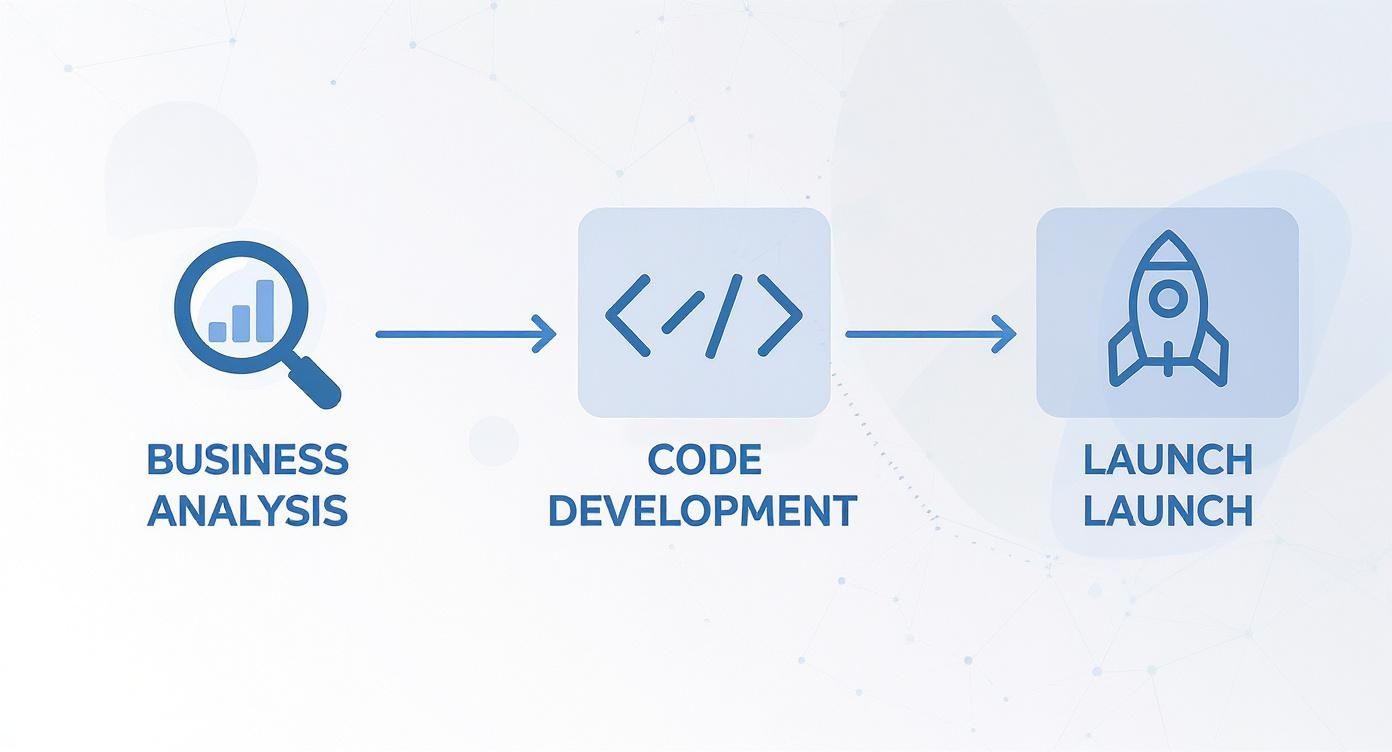
As you can see, each stage logically follows from the previous one, ensuring a high-quality result at the end.
And here is how it looks in a more detailed table that shows what happens at each step.
Comparison of website development stages
| Stage | What happens | Key result for the client |
|---|---|---|
| Analytics and brief | Deep dive into the business, market and competitor analysis, goal definition. | Clear understanding of what the website should be like to solve business tasks. |
| TS and prototype | Creating a detailed work plan and a visual scheme of the website structure. | Approved website logic and structure, confidence in future usability. |
| UI/UX Design | Developing a visual style, colors, fonts, and creating a user-friendly interface. | Ready design mockups that show the final look of the website. |
| Development (Frontend/Backend) | Markup of the design, programming the functionality, connecting to a CMS. | A working version of the website that displays correctly on all devices. |
| Testing and launch | Checking all functions for errors, filling with content, migrating to hosting. | A fully functional, tested website ready to receive visitors. |
This table is a kind of roadmap that helps keep your finger on the pulse of the entire process.
Stage 3: Design and visual concept
When the «skeleton» is ready, it’s time to add the «muscles» and create the appearance. A UI/UX designer is responsible for this, turning the black-and-white scheme into an attractive and clear interface.
- UI (User Interface) is about aesthetics. The designer selects colors, fonts, and icons, creating a visual style that suits your brand.
- UX (User Experience) is about usability. The designer ensures it’s easy and pleasant for the visitor to use the site.
In the end, you receive ready design mockups of all main pages. We discuss them together and make adjustments. Only after your «yes» do the mockups go into development. This helps avoid surprises and lets you see the final look of the site before the first line of code is written.
Stage 4: Development and testing
This is the most complex technical stage where images turn into a live, working website. The work goes in two directions:
- Frontend development: This is the «face» part. Using code (HTML, CSS, JavaScript), the specialist builds the layouts. They ensure the site looks good on a large monitor and on a smartphone screen alike.
- Backend development: This is the «brain» of the site, hidden from the user’s eyes. The developer connects a content management system (CMS), configures databases, contact forms, online payments, and other complex mechanisms.
When development is complete, the most responsible part begins — testing. We check every button, every link, every form. We test the site in different browsers and on different devices. Our task is to find and fix all possible errors.
Stage 5: Launch and support
The final chord! We fill the website with your texts, photos, and videos, migrate it to hosting, and ceremoniously launch it. After that, we will definitely conduct a short training session for you so you can add news or products yourself through a convenient admin panel.
It is worth noting that the cost of turnkey website development in Ukraine usually includes not only technical work. As a rule, after getting acquainted with the client’s business, a full-fledged marketing study is carried out with an analysis of the audience and competitors. It is precisely this approach, combining development with marketing, that results in an effective product.
But our cooperation does not end with the launch. We are always ready to provide technical support and help with further promotion and project development. After all, a website is a living tool that should grow along with your business. You can see real examples of our launched projects in our Moveiton web studio portfolio.
What determines the cost of a turnkey website
When you decide to order a turnkey website, one of the first and most important questions is, of course, the price. The project cost is not some random figure. It is the result of simple math: the number of team hours multiplied by the complexity of the tasks.
Imagine you are buying a car. The base configuration costs one amount. But if you add a more powerful engine, a leather interior, and a premium audio system, the price will be completely different. It’s the same with websites. A simple landing page for product presentation and a complex online store with thousands of products and CRM integration are projects of completely different scale. The price directly depends on how much work is needed to bring your idea to life.
Key pricing factors
To build a realistic budget, you need to understand the «bricks» that make up the final cost. Let’s break down the main elements that affect the price.
- Type of website. This is the foundation. Creating a one-page landing is much faster and cheaper than a multi-page corporate portal or a complex e-commerce platform with a personal account, bonuses, and a loyalty system.
- Design: template or unique. A ready-made template is a quick start, but it limits uniqueness and flexibility. A unique design developed from scratch for your brand costs more but creates a strong visual identity and allows you to implement any ideas.
- Functionality complexity. Each additional module means additional developer hours. A service calculator, online booking, payment gateway integration, user account — all of this adds to the final cost.
- Integrations with third-party services. Do you need to «connect» the site with your CRM system, email marketing services, inventory software (for example, 1C), or delivery services? This will require extra development work.
- Content Management System (CMS). The choice of platform matters too. Development on popular CMSs like WordPress can be cheaper. At the same time, building a site on a custom CMF like our Moveiton Atom provides higher speed, security, and maximum simplicity in management, albeit requiring different investments.
Approximate prices in the Ukrainian market
To give you a general idea, turnkey website development in Ukraine has become an extremely popular service. According to analytical reports, the simplest business card websites can cost from $300-$900, while corporate resources start from $800-$3000.
The price for online stores in professional studios starts from 50,000 – 150,000 UAH, and for complex projects can reach half a million. This variation in prices perfectly illustrates how flexible and competitive the Ukrainian market is, offering solutions for businesses of any scale.
Remember: a price that is too low is almost always a red flag. An offer like «a website for 5000 UAH» often means a low-quality template, no testing, hidden fees, or a complete lack of further support.
Hidden and additional costs
When ordering a website, keep in mind the related expenses that are not always included in the developer’s initial proposal. To avoid unpleasant surprises, it’s better to consider in advance:
- Domain and hosting. These are annual payments for your website’s name and server space.
- Paid plugins and licenses. Some functionality may require purchasing premium modules or fonts.
- Content writing. If you don’t have ready-made texts, copywriting services are paid separately.
- Technical support. After launch, the site needs updates and monitoring, and this is usually a separate service.
A comprehensive budgeting approach will help you avoid unpredictable expenses. To better understand how much website development costs and which factors will be relevant in the near future, check out our detailed article.
How to choose a reliable developer

Choosing a partner for turnkey website development is, without exaggeration, 80% of the project’s success. The market is flooded with offers, and finding that one team or specialist among thousands of options can be challenging.
There is a real boom in the Ukrainian market: the number of agencies and freelancers is growing rapidly. On the Freelancehunt platform alone, there are more than 2,300 experienced developers registered. On the one hand, such competition allows you to find an optimal solution in terms of price and quality. On the other hand, it’s easy to get lost.
Let’s figure out how to distinguish a true professional from an amateur and what to pay attention to first.
Portfolio evaluation criteria
A portfolio is not just a gallery of beautiful images but the main proof of experience. It’s not enough to scroll through screenshots; you need to dive deeper.
- Relevance and suitability. Does the contractor have recent works completed in the past year? Have they worked in your or a similar business niche? This matters because trends and technologies change quickly.
- Field testing. Don’t be lazy to follow the links and click through the sites. Are they convenient to use? Do they load quickly? Does everything work as it should?
- Depth of case studies. Real pros don’t just show the final look. They tell the story: what tasks they faced, how they solved them, and what specific results they achieved. Look for cases with numbers: conversion growth, traffic increase, improved behavioral metrics.
The best portfolio is not the one with the most projects, but the one where each project effectively solves a specific business problem.
Freelancer or web studio: whom to choose
This is one of the key decisions and depends on the scale of your project, budget, and requirements. Both options have their advantages and disadvantages.
Contractor comparison table
| Criterion | Freelancer | Web studio |
|---|---|---|
| Price | Usually lower, as there are no office and large team costs. | Higher due to team, management, office, and tax expenses. |
| Communication | Direct contact with a single contractor. Simple and fast. | Through a project manager who structures the process. |
| Competencies | Usually strong in one or two areas (e.g., design or code). | A comprehensive team (designer, developer, marketer, SEO specialist). |
| Reliability | Higher risk: illness or force majeure can stop the work. | Higher, as it’s possible to replace a specialist within the team. |
| Contract | Often work without a formal contract, which carries risks. | Always sign a contract that protects both parties. |
If you need a small project with a clear task, such as a landing page, a good freelancer can be an excellent choice. But for complex corporate websites or online stores, where the coordinated work of several specialists is required, it is more reliable to contact a web studio. Learn more about how working with a web studio differs in our separate article.
Questions to ask at the first meeting
The first conversation is your chance to assess the expertise of a potential partner. Listen not only to what they say, but also to how they say it.
Here is a list of questions that will help you make the right choice:
- How exactly will you research my business, audience, and competitors?
- What stages does your development process consist of, and what is my role at each stage?
- Who will be my point of contact and how often will we communicate?
- What guarantees do you provide after the website launch? Do you offer technical support?
- Will I be able to manage the website content myself? Do you provide training?
- What will we do if I do not like the proposed design or an interim result?
Professionals will bombard you with counter-questions, trying to dig into your business goals. If they only ask about the desired button color — that’s a red flag.
How a client should prepare for the project
The best projects are born in close collaboration. When you order turnkey website development, your preparation can become the secret ingredient that accelerates development, improves the result, and even helps save money. The better you understand what exactly you want, the more precisely the team will implement your ideas.
Let’s draw an analogy. Imagine you order a suit from a good tailor. You won’t just say: «Sew something nice». You will likely explain what event it is for, which style you prefer, and what fabric to use. It’s exactly the same with a website: the more details you provide at the start, the better it will «fit» your business.
Define the main goal of the website
The first and most important step is to honestly answer the question: «Why does my business need a website?» The answer «just to have one» leads nowhere. The goal must be specific, as it determines the entire structure, design, and functionality of the future resource.
Here are the most common business goals clients come to us with:
- Direct sales. The main task is for customers to purchase products or services directly on the site (a classic online store or a site with online booking).
- Lead generation. The site should work as a magnet for potential customers’ contacts: via forms, quizzes, or consultation requests.
- Image and information. The resource works as your digital business card, demonstrating your expertise, portfolio, and company advantages.
- Customer support. The site can become a knowledge base, a personal account, or a convenient platform for communication with your regular clients.
A clearly defined goal is your internal compass that will keep the project on the right course.
Our experience shows that a clear understanding of business goals at the start helps avoid up to 30% of revisions at the design and development stages. This directly saves your time and money.
Collect references and prepare content
Once the goal is set, it’s time to move to the visual and content parts. Your help here is invaluable, as no one knows your business and customers better than you do.
1. Find website examples (references)
Collect 3–5 links to websites you like and 2–3 you definitely don’t. Most importantly, explain what exactly appeals to or repels you: structure, colors, block placement, style of presenting information. This helps the designer instantly understand your taste.
2. Prepare basic content
Even the most beautiful website without content is just an empty shell. Therefore, it’s worth preparing in advance:
- Logo in high quality (preferably in vector format: .svg, .ai, .eps).
- Brand colors and fonts, if you have a brand book.
- Texts about the company, descriptions of services or products.
- High-quality photos of your products, team, office.
3. Think through the key functionality
Make a simple list of features that must be on the site. For example: online payments, cost calculator, appointment form, multilingual support, blog.
Such preparation will not only make life easier for the development team but will also make the entire turnkey website creation process more predictable and manageable for you. You will not be a passive observer but a full-fledged participant steering your digital ship to success.
Frequently asked questions about turnkey websites
When it comes to turnkey website development, clients always have many questions. And this is absolutely normal — you are investing money in an important business tool and want to be sure everything goes as it should.
To dispel your doubts, we have collected answers to the questions we most often hear from clients. This will help you better understand the process: from timelines and pricing to further website management.
How long does it take to build a turnkey website?
Perhaps this is the first thing everyone is interested in. The short answer: it all depends on the complexity of the project. It’s like construction: a small garden house can be built in a few weeks, while a solid cottage takes months. The same is true for websites.
To make it easier to navigate, here are approximate timelines:
- Simple landing page. Such a website is usually ready in 2-4 weeks. A great option to quickly launch a promotion or test demand for a new service.
- Corporate website. A multi-section resource with a unique design and a basic set of features takes on average 1.5-3 months of work.
- Online store. Developing an e-commerce platform with a product catalog, payment systems, and a personal account can take from 3 to 6 months, and longer for very large projects.
It’s important to remember that these figures account for all stages — from analytics to testing. Most delays occur not because of developers, but due to late content delivery or feedback from the client.
What is included in the price, and what is paid separately?
The «turnkey» service means you receive a product fully ready for operation. But it’s important to understand what is included in this package and what is considered an additional option.
Usually, the cost of a turnkey website includes:
- Market and competitor analysis.
- Preparation of the technical specification (TS).
- Development of a unique design.
- Markup and programming (frontend and backend).
- Mobile responsiveness.
- Connection to a Content Management System (CMS).
- Basic SEO optimization (proper structure, meta tags).
- Filling up to 10-15 pages with your content.
- Testing and deployment on hosting.
And here is what usually requires additional payment:
- Domain and hosting. This is like renting land and an address for your house — annual payments.
- Copywriting. If you don’t have ready-made content, copywriter services are paid separately.
- License purchases. These can be paid fonts, stock photos, or premium plugins.
- Further support and promotion. After launch, the site needs maintenance and advertising, which are separate services.
Tip: Always clarify the full list of works included in the price in detail before signing a contract. This will help avoid misunderstandings and unforeseen expenses.
Will I be able to manage the site myself after launch?
Yes, of course! This is one of the key advantages of turnkey website development. We fully understand that you don’t want to call a developer every time you need to update a phone number or add a blog post.
That’s exactly why the website is built on a Content Management System (CMS). At Moveiton, we use our own development — CMF Atom. It is much simpler to manage than popular but often overloaded systems like WordPress or Joomla.
Our admin panel is intuitive. After the project is completed, we will definitely provide training for you or your staff. You will easily be able to:
- Add and edit pages.
- Change texts and upload photos.
- Manage the product catalog.
- Publish news and articles.
No programming skills are required. If you can use a text editor, you will definitely handle website management.
What is the difference between a template design and a unique one?
It’s like choosing between a ready-made suit from a store and a tailor-made one. A template design is that ready-made suit: it may fit fairly well, costs less, and is available immediately. But it won’t be unique, and you’re unlikely to get a perfect fit.
Template design:
- Pros: Fast, inexpensive, you can see the result immediately.
- Cons: Not unique (a competitor might have the same site), limited functionality, difficult to change drastically, often slower due to excess code.
Unique design:
- Pros: Fully matches your brand and business goals, an exclusive look, flexibility to implement any ideas, better user experience.
- Cons: More expensive and requires more development time.
For a serious business that plans to grow and wants to stand out in the market, a unique design is the right investment. It creates the right impression, increases customer trust, and better converts visitors into buyers.
We hope these answers helped you understand the process. If you still have questions or are ready to discuss your future project, the Moveiton team is always in touch.
Order a free consultation, and we will help turn your idea into an effective business tool!